Music

Table selection, HSA, LugRadio, Music, Photographers, New Media

Monday, April 21st, 2008

A few observations and things learned from the last eight days.

Go to a page with a table, for example this one (sorry, semi-nsfw). Hold down the control key and select cells. How could I not have known about this!? Unfortunately, copy & paste seems to produce tab separated values in a single row even when pasting from mutliple rows in the HTML table (tried with Firefox and Epiphany). Still really useful when you only want to copy one column of a table, but if you want all of the columns, don’t hold down the control key and row boundaries get newlines as they should rather than tabs. (Thanks Asheesh.)

I feel really stupid about this one. I’ve assumed that a (US) was a spend within the year or lose your contributions arrangement, but that’s what a Flexible Spending Account is (I have no predictable medical expenses, so such an account makes no sense for me). A HSA is an investment account much like an IRA, except you can spend from it without penalty upon incurring medical expenses rather than old age. You can only contribute to a HSA while enrolled in a high deductible health insurance plan, which I’ll try to switch to next year. (Thanks Ahrash.)

I saw a few presentations at LugRadio Live USA, in addition to giving one. Miguel de Icaza’s on (content roughly corresponding to this post) and Ian Murdock’s on were both in part about software packaging. Taken together, they make a good case for open source facilitating cross polination of ideas and code across operating system platforms.

Aaron Bockover and Gabriel Burt did a presentation/demo on , showing off some cool track selection/playlist features and talking about more coming. I may have to try switching back to Banshee as my main audio player (from Rhythmbox, with occasional use of Songbird for web-heavy listening or checking on how the program is coming along). Banshee runs on Mono, and both are funded by Novell, which also (though I don’t know how their overall investment compares) has an .

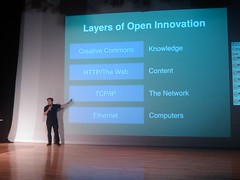
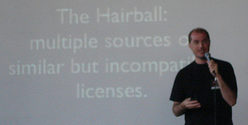
John Buckman gave an entertaining talk on open source and open content (including the slide at right). My talk probably was not entertaining at all, but used the question ‘how far behind [free/open source software] is free/open culture?’ to string together selected observations about the field.

Benjamin Mako Hill did a presentation on Revealing Errors (meant both ways). I found myself wanting to be skeptical of the power of technical errors to expose political/power relationships, but I imagine the concept could use a little hype — there’s definitely something there. The talk made me more sensitive to errors in any case. For example, when I transferred funds from a money market account to checking to pay taxes, an email notice included this (emphasis in original):

Your confirmation number is 0.

Zero? Really? The transaction did go through.

Tuesday I attended the Media Web Meetup V: The Gulf Between NorCal and SoCal, is it so big?, the idea being (in this context pushed by Songbird founder Rob Lord; I presented at the first Media Web Meetup and have attended a few others) that in Northern California entrepreneurs are trying to build new services around music, nearly all stymied by protectionist copyright holders in Southern California. I really did not need to listen to yet another panel asking how the heck is the music recording distribution industry going to use technology to make money, but this was a pretty good one as those go. One of the panelists kept urging technologists to “fix [music] metadata” as if doing so were the key to enabling profit from digital music. I suppressed the urge to sound a skeptical note, as investing more in metadata is one of the least harmful things the industry might do. Not that I don’t think metadata is great or anything.


Wendy Seltzer / CC BY

Thursday evening I was on a ‘Copyright 2.0′ panel put on by the American Society of Media Photographers Northern California. I thought my photo selection for my first slide was pretty clever. No, copyright expansion is not always good for the interests of professional photographers. The other panelists and the audience were actually more open minded (both meanings) than I expected, and certainly realistic. The photographer on the panel even stated the obvious (my paraphrase from memory): new technology has allowed lots of people to explore their photographry talents who would otherwise have been unable to, and maybe some professional photographers just aren’t that good and should find other work. My main takeway from the panel is that it is very difficult for an independent photographer to successfully pursue unauthorized users in court. With the sometime exception of one, the other panelists all strongly advised photographers to avoid going to court except as a last resort, and even then, first doing a rational calculation of what the effort is likely to cost and gain. The best advice was probably to try to turn unauthorized users into clients.

Friday evening I went to San Jose to be on a panel about New Media Artists and the Law. Unlike Thursday’s panel, this one was mostly about how to use and re-use rather than how to prevent use. This (and some nostalgia) made me miss living in Silicon Valley — I lived in Sunnyvale two years (2003-2005) and San Jose (2005-2006) before moving back to San Francisco. Nothing really new came up, but I did enjoy the enthusiasm of the other panelists and the audience (as I did the previous day).

Staturday I went to Ubuntu Restaurant in Napa, which apparently does vegetable cuisine but does not market itself as vegetarian. I think that’s a good idea. The food was pretty good.

I’ve been listening to Hazard Records 59 and 60: Calida Construccio by various and Unhazardous Songs by Xmarx. Lovely Hell (mp3) from the latter is rather poppy.

MIN US$750k for NIN

Tuesday, March 4th, 2008

The $300 “ultra deluxe edition” of , limited to 2500 copies, sold out in a couple days (I believe released Sunday, no longer available this morning). There are some manufacturing costs, but they don’t appear to be using any precious materials. So if an artist typically makes $1.60 on a $15.99 CD sale, profit from sales of the limited edition already matches profit from a CD selling hundreds of thousands of copies.

Then there are non-limited sales of a $75 merely “deluxe edition”, $10 CD, and $5 download, and whatever other products NIN comes up with around Ghosts.

The ultra deluxe success seems to me to validate the encouragement by some to pursue large revenue from rabid fans and collectors willing and able to pay for personalization, authenticity, embodiment, etc., rather than attempting to suppress zero cost distribution to the masses.

Speaking of distribution, click on the magnet to search for a fully legal P2P download of Ghosts, assuming you have the right filesharing software installed.

nin_ghosts_I-IV_mp3.zip (283.7 MB)

SanFran MusicTech Summit

Monday, February 25th, 2008

At today’s very well produced SanFran MusicTech Summit on a panel called “The Paradise of Infinite Storage” said that the existence of a recording industry protected by copyright is a very recent phenomenon and conjectured that one could take the position that all of the music created to this point is enough. I don’t recall whether he spelled it out, but the implication being that all music should be available for free and we shouldn’t worry about the creation of more music.

This really upset someone in the audience who identified themselves as representing songwriters for decades. This person righteously stipulated that music has value, musicians must be paid, and that if recording copyright is recent, so was the abolition of slavery. It is really he didn’t make reference to Nazis instead of slavery. Hmm, they did use slave labor.

Unfortunately Godwin said he did not agree with the conjecture and agreed with the vacuous statement that music has value (duh, consumers spend valuable time listening to music). But if the conjecture is not plainly correct, it is at least extremely weighty. Given that a vast amount of music exists and much more will be created regardless of protection, any harms done (e.g. to free speech and innovation) in the name of incentivizing marginal additions to this vast supply must be viewed with extreme skepticism.

There are basically two perspectives in the ‘Music and Technology‘ conversation. One’s priority is to ensure copyright holders are paid, with a strong preference for protecting existing revenue streams, and the other’s priority is to build cool stuff with new technology. Both were present in every part of this conference that I saw.

Probably the most significant example of the latter present was Lucas Gonze demoing the Yahoo! Media Player, which does a great job of playing media linked on a web page, with nice affordances for that environment.

Copypop

Saturday, February 23rd, 2008

Three times I’ve linked to the 2005 column If pirating grows, it may not be the end of music world about the music industry in China.

1: Witness massive production of art where expected profit from sales of copies and licensing is nil, both outside the content industry and where restrictions on copying are not enforced.

2: There is some very imperfect evidence from China that without copyright mass culture will still be star-driven and repulsive.

3: But we can also look to markets that started from a very different place, e.g., China.

A new BBC story, ‘Chaos’ of China’s music industry also says that pop stars earn through sponsorship:

The singer made about $2000 (£1,000) a month from music royalties and live shows with her band Mika Bomb when she lived in London.

But in China, her band Long Kuan Jiu Duan can almost double that by singing just one song at a commercial gig.

At these gigs, artists get paid a set amount by companies or promoters regardless of how many tickets they sell.

I assume a “commercial gig” is some kind of promotional event, but I’d like to read a more in depth look at the economics of pop music in China. (I have little doubt that the economics of music worth listening to is little different than in the U.S. — made for love at a financial loss or sometimes subsidized by grants or academic employment.)

This post is also an excuse to link to Let’s Do Like Them, which expresses one of my top peeves.

The major political issue of today?

Tuesday, December 4th, 2007

The incredibly productive Kragen Sitaker, in Exegesis of “Re: [FoRK] Calling [redacted] and all the ships at sea.”:

The major political issue of today [0] is that music distribution companies based on obsolete physical-media-distribution models (“record labels”) are trying to force owners of new distribution mechanisms, mostly built on the internet, to pay them for the privilege of competing with them; the musical group “The Grateful Dead” used to permit their fans to distribute their music by making copies of taped performances, and most of the money the Dead made came from these performances; it is traditional for performances not to send any revenue to the record label. Long compares the record labels to buggy-whip manufacturers, who are the standard historical symbol for companies who went out of business because of technological change.

This clearly relates to the passage the footnote is attached to, which is about the parallel between Adam Smith’s economic “invisible hand” and the somewhat more visible hand that wrote the king’s doom on the wall in Daniel; in this case, the invisible hand has written the doom of the record companies on the wall, and their tears will not wash out a word of it. What this has to do with Huckleberry Finn’s prohibition on seeking symbolism or morals in the book, I don’t know, although clearly Huckleberry Finn’s prohibition relates to mortals hiding messages in texts.

[0] Yes, this means I think this is more important than the struggle over energy, or the International Criminal Court, or global warming, or nuclear proliferation — the issue is whether people should be permitted to control the machines they use to communicate with one another, in short, whether private ownership of 21st-century printing presses should be permitted. (Sorry my politics intrude into this message, but I thought “the major political issue of today” required some justification, but needs to be there to explain the context to people reading this message who don’t know about it.)

That will probably seem a pretty incredible claim, but I often agree, and think Sitaker understates the case. Music distribution companies are only one of the forces for control and censorship. The long term issue is bigger than whether private ownership of 21st-century printing presses should be permitted. The issue is whether individuals of the later 21st-century will have self-ownership.

DRM: the good bullshit story that got past Doug Morris

Monday, November 26th, 2007

New York Magazine cites an interview with CEO Doug Morris from the WIRED December issue (not yet online) that supposedly shows that Morris and his industry are utterly clueless. The excerpt from NYMag, emphasis added:

“There’s no one in the record industry that’s a technologist,” Morris explains. “That’s a misconception writers make all the time, that the record industry missed this. They didn’t. They just didn’t know what to do. It’s like if you were suddenly asked to operate on your dog to remove his kidney. What would you do?”

Personally, I would hire a vet. But to Morris, even that wasn’t an option. “We didn’t know who to hire,” he says, becoming more agitated. “I wouldn’t be able to recognize a good technology person — anyone with a good bullshit story would have gotten past me.”

Actually, knowing your limitations is pretty smart. Too bad the industry did not stick to the strategy of not hiring technology people. Music startups would’ve flourished, and the industry could have snapped up the obvious winners. Instead, Morris and friends eventually fell for a complete bullshit story — — that killed nascent startups and paved the way for Apple’s much-hated dominance.

Copyright turns even really smart technologists into disingenuous and even dangerous technology idiots (including me on occasion — the claims I dismissed in that last link, while overblown, may have some substance), so non-technologists should be really wary, and consistently so.

Update 20071128: The WIRED article is now online. Despite its sneering tone, I think comes off as a shrewd businessperson.

The future of “music technology” and the “music industry”

Tuesday, September 11th, 2007

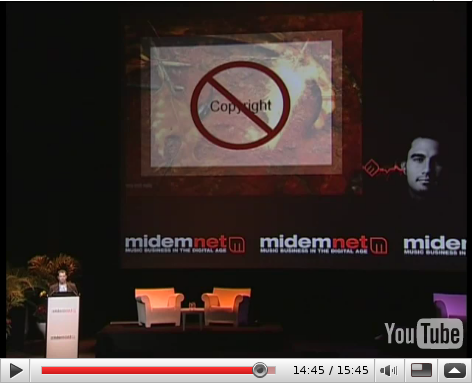
A few weeks ago I moderated a panel on DRM at a “music technology” conference. I wrote it up on the Creative Commons blog. Short version is a consensus from non-activists that music DRM is on its way out.

But what I want to complain about here is the use of “music industry” understood to mean the recording distribution industry and “music technology” understood to refer to use of the net by the same industry. Similarly, “future of music” understood to refer to the development or protection of recording distribution industry business models in the face of digital networks. Each of these gets under my skin.

My contention is that the future of music is determined by changes in music making technology and culture. The recording distribution industry has just about nothing to do with it. It seems that every new genre from ancient history to present has sprung from the latest in music making technology and cultural antecedents, and developed its essential forms before the recording distribution industry got a clue (or recently, started to sue).

I may be overstating my case, especially with regards to rock, but fuck rock stars.

If you’re interested in the actual future of music and want to look for it in an industry more narrow than “information technology”, it’s the musical instruments industry that you want.

SXSW: Art, like, inspires me to design

Saturday, March 10th, 2007

The nearest The Influence of Art in Design came to its topic was showing a couple web sites that use color schemes to match fine art visuals incorporated in the site. Otherwise, it was all about “inspiration.” You should really try listening to some different music and see how that changes your creative process. Or maybe go to a museum and think about what you like about the pieces you see. Yeah.

The best quote I’ve heard attempting to relate art and design is “Art is the experimental end of design” from Caleb Chung, designer of the Furby. Sounds nice to me, but I don’t know how much water it holds. Is there a website or book that explores this using concrete examples?

Gratis unencumbered MP3 download is not news

Monday, February 26th, 2007

, a moderately successful band with one top 40 hit in 1997, has released their latest (2005) album as an unencumbered MP3 download with an essay explaining “why we’re releasing our latest album for free on the Internet,” covered by Cory Doctorow, Tim O’Reilly and many others.

Big deal. In 2007 re-releasing an old album as a DRM-free gratis download with no explicit rights granted to share or remix, should not be news, unless a major label is involved.

Jamendo is my current favorite example of 2,500 reasons (albums) why this is not news, but there are thousands of others.

If you need an essay to go with your music, teleport back to 1998 or earlier (I recall reading a version of Ram Samudrala’s essay in 1995).

Update 20070227: The Harvey Danger album has been available for download since September 2005 (when Doctorow wrote about it in Boing Boing, link above). It shouldn’t have been newsworthy then either, but I’m a fool for not noticing that now it is old non-news. A commenter at Techdirt pointed this out.

Digital Rights Managements

Tuesday, February 6th, 2007

Even I have to admit Steve Jobs’ DRM-bashing letter is pretty good:

The third alternative is to abolish DRMs entirely. Imagine a world where every online store sells DRM-free music encoded in open licensable formats. In such a world, any player can play music purchased from any store, and any store can sell music which is playable on all players. This is clearly the best alternative for consumers, and Apple would embrace it in a heartbeat. If the big four music companies would license Apple their music without the requirement that it be protected with a DRM, we would switch to selling only DRM-free music on our iTunes store. Every iPod ever made will play this DRM-free music.

But what’s up with DRMs?

Via Tim Lee.

Addendum: Lots of people want to sell their music DRM-free at the iTunes store.