Archive for the ‘Health’ Category

Vegan cuisine day

Thursday, November 1st, 2007

November 1 was apparently World Vegan Day (via Zenpawn).

Earlier this year prior to visiting a city I asked someone who recently lived in that city and since returning to San Francisco has been on a vegan diet whether they knew of any great vegan restaurants in the city I would visit. Their reply was something like “no, I’ve only been vegan since I returned.” Which strikes me as odd — as if one would not eat at a Chinese restaurant because one is not Chinese.

I’ve encountered (mostly through overhearing) this strange attitude before — people who think that going to a vegan or merely vegetarian restaurant is crazy unless one is a vegan or vegetarian, or just maybe if a crazy veg*n friend or relative drags one along. I’ll chalk this up to a combination of general lack of imagination and negative reaction to vegan identity entrepreneurs.

As an alternative, I propose November 2 as “Vegan Cuisine Day” — the message is not “Go Vegan” but “go to a vegan restaurant” and discover a new cuisine.

Debunking debunking bad debunkers

Monday, January 8th, 2007

Yesterday I attended a talk by Aubrey de Grey, the purpose of which seemed to be to get feedback on messaging to potential donors. The feedback was good, but perhaps hard to hear. I hope de Grey uses some of it. Much of the feedback could apply to anyone selling a radical program.

Don’t dwell on your critics. Debunking detractors is too easy, comfortable, and personal. Every second you’re telling me why your detractors are wrong you’re not telling me how your idea will work. Suspicious. Reason puts it well:

[E]very new idea, every plan, arrives associated with a raft of dumb objections, but you won’t convince a smart, educated audience of the merits of your idea by taking time to dispel the dumb objections. The world is full of dumb ideas - many more of them than good ideas. Dumb ideas also arrive accompanied by dumb objections (just look at any average day in politics…), and one of the chores of being involved in a funding organization is to listen to people trying to demonstrate that a dumb idea has merit by demolishing dumb objections to that dumb idea. This is a form of rhetorical alchemy - often performed quite innocently by those sold on a plan that just won’t work - that raises red flags for folk in funding organizations.

Don’t dwell on the of your program (unless they’re short term money makers). De Grey claimed that repairing each of the seven causes of aging (with the possible exception of mutant mitochondria) individually would cure a raft of diseases. If true, this should be more than adequate to fund fixes for each of the seven causes individually without ever mentioning any potential for life extension. De Grey claimed this is a hard argument to make, as curing individual diseases through other means will be less expensive than the relevant cause of aging fix. If true, de Grey is either extremely optimistic about conventional medical research or is lying about the level of funding needed for his program, considering the $US billions spent on individual disease research annually. I suspect de Grey is wrong on this point and hope other researchers and organizations take an engineering-fixes-for-causes approach via funding for individual disease research.

Since my last (peevish) post mainly about de Grey’s work slightly over a year ago, Methuselah Mouse Prize total ($1.6m received plus $2.5m committed) funding has risen by nearly $1m. More importantly $4m has been raised for the research program, with LysoSENS and MitoSENS work having begun. De Grey also had a more concrete plan for ramping up the research program as funding becomes available than I recall having seen before; unfortunately I couldn’t find it quickly at sens.org.

I still highly recommend giving to the Methuselah Mouse Prize/Foundation. Highly recommend would be an understatement. I don’t know of a more important cause.

Somewhat relatedly, I want to reiterate that even without repair technologies, increased lifespan over the past century was concomitant with decreased absolute time spent in a diseased state and that on an individual level, a healthy life expectancy increase is available now, no technology required.

Update 20070109: Reason argues that if the focus is not on fighting aging, progress will only be incidental and inefficient. Perhaps, but if nearly everyone is in a “pro-aging trance” as de Grey is fond of saying, should your marketing really depend on breaking that trance? Let’s face it, in all probability that trance will not be broken and relative to the medical innovations required is not even a major obstacle. Individuals will nearly always choose to prolong health and life (when self-control is not involved anyway), regardless of their emotional or religious attachments to death. In my view de Grey has done a great service by identifying a set of targets for repair and recommending an engineering approach. If there’s value in his approach it will be used by others with smaller goals resulting in faster and more efficient incidental progress against aging. The indefinite lifespan part of his pitch is just Macho Flash:

Macho Flash WORKS internally — at raising the most money from a small group of people (which then also KEEPS us small and insignificant).

Dangerous Optimism

Monday, January 1st, 2007

I never got around to commenting on responses to the 2006 Edge Annual Question — “What Is Your Dangerous Idea?” — as most were uninteresting, not dangerous, or simply lame.

It must’ve been the question, as this year’s responses — to “What Are You Optimistic About? Why?” — make for good reading. I’ll excerpt a few that resonate with themes I go on about.

Steven Pinker on The Decline of Violence:

Even the mass murders of the twentieth century in Europe, China, and the Soviet Union probably killed a smaller proportion of the population than a typical hunter-gatherer feud or biblical conquest. The world’s population has exploded, and wars and killings are scrutinized and documented, so we are more aware of violence, even when it may be statistically less extensive.

My optimism lies in the hope that the decline of force over the centuries is a real phenomenon, that is the product of systematic forces that will continue to operate, and that we can identify those forces and perhaps concentrate and bottle them.

James O’Donnell says Scientific Discoveries Are Surprisingly Durable:

But the study of the past and its follies and failures reveals one surprising ground for optimism. In the long run, the idiots are overthrown or at least they die. On the other hand, creativity and achievement are unique, exciting, liberating—and abiding. The discoveries of scientists, the inventions of engineers, the advances in the civility of human behavior are surprisingly durable.

Clay Shirky on Evidence:

We will see a gradual spread of things like evidence-based politics and law — what is the evidence that this expenditure, or that proposed bill, will have the predicted result? The expectation that evidence can answer questions about the structure of society will discomfit every form of government that relies on sacrosanct beliefs. Theocracy and communism are different in many ways, but they share the same central bug — they are based on some set of assertions that must remain beyond question.

Jamshed Bharucha on The Globalization of Higher Education:

We are all better off when talent is realized to its fullest—even if it crosses borders.

I didn’t count, but I think the subject mentioned most often was climate change, with solar power as the thing most were optimistic about. My favorite take on climate change was Gregory Benford on Save The Arctic:

So: despair? Not at all. Certainly we should accept the possibility that anthropogenic carbon emissions could trigger a climactic tripping point, such as interruption of the gulf stream in the Atlantic. But rather than urging only an all out effort to shrink the human atmospheric-carbon footprint, my collaborators and I propose relatively low tech and low expense experiments at changing the climate on purpose instead of by mistake.

If we understand climate well enough to predict that global warming will be a problem, then we understand it well enough to address the problem by direct means.

There are also several good entries on health, life extension, and also networks-will-change-publishing — but my, isn’t the last relatively boring?

One last favorite, on human enhancement, Andy Clark on The End Of The ‘Natural’:

Second, the biological brain is itself populated by a vast number of hidden ‘zombie processes’ that underpin the skills and capacities upon which successful behavior depends. There are, for example, a plethora of such unconscious processes involved in activities from grasping an object all the way to the flashes of insight that characterize much daily skilful problem-solving. Technology and drug based enhancements add, to that standard mix, still more processes whose basic operating principles are not available for conscious inspection and control. The patient using a brain-computer interface to control a wheelchair will not typically know just how it all works, or be able to reconfigure the interface or software at will. But in this respect too, the new equipment is simply on a par with much of the old.

In sum, I am optimistic that we will soon see the end of those over-used, and mostly ad hoc, appeals to the ‘natural’. May we all have a thoroughly unnatural New Year.

A highly agreeable toast.

Many of the responses contain very rough predictions, reminding me of prediction registries, an idea Robin Hanson has said would obtain 80% of the benefits of prediction markets (I doubt the number is that high) and also promoted by David Brin. I think prediction markets and registries are almost entirely complementary.

I like Brin’s point that “One advantage of registries is that they can be involuntary.” A pundit can only avoid inclusion by effectively not making predictions (which may include being wishy-washy and imprecise). I conjecture that DiscourseDB (I mentioned previously) is a model of what a prediction registry would look like — just imagine cataloging “will” rather than “should” opinions, and add evaluation.

I’m surprised that none of the responses (I could have missed one) took the (unintended?) bait offered by combining the 2006 and 2007 questions: Is optimisim dangerous?

That depends on the subject of optimism. I think people tend to be dangerously optimisic about the outcomes of authoritarian processes, including both obvious societywide authoritarianism and conscious decisions made by individuals, but dangerously pessimistic about decentralized processes, including listening to external advice at the individual level.

Via Boing Boing, Marginal Revolution, or EconLog, all of which appeared in one batch of feed updates.

CR related questions

Sunday, November 5th, 2006

Several people have asked me roughly the same questions after noticing me in last week’s NYT article on . I am not a physician, nutritionist, or even particularly knowledgeable amateur. In other words, I don’t know what the hell I’m talking about. Common questions with my answers follow anyway.

I don’t think I can restrict calories, what can I do to stay healthy?

You can still try to optimize your nutrition (the ON in CRON). Eat more vegetables, fewer grains, and cut out sugar to the maximum extent possible. You’ll probably end up eating fewer calories unintentionally.

I am extremely active, e.g., I run marathons. How can I do CR?

You’ll probably have to cut back. You need to consume lots of calories to perform at the highest levels in many sports and to participate in endurance sports. Kenton Mullins is a well known example in the CR community. From a news story in 2004:

The 37-year-old former body builder went from 4000 to 2000 calories a day. And to conserve energy, he surfs four hours a week instead of his usual 20.

Note, he still surfs.

If you do run marathons or similar and you want to stay healthy you may want to reconsider irrespective of CR. Read Art de Vany’s endurance training: death, injury and risk archives. De Vany, who is also skeptical about CR, gave an interesting presentation at CR IV that I may eventually summarize.

I don’t think I can restrict calories, should I take supplements?

I’d say “not yet.” Resveratol supplements are still expensive and of uncertain quality and effect. I agree with the view of Fight Aging:

The gold standard for science to back a form of metabolic manipulation is the research supporting the practice of calorie restriction. It is an open question to whether some shared mechanisms mean that calorie restriction mimetics like resveratrol can piggy-back on this wealth of data to a lower risk. But why take that risk? If you’re healthy and young, why risk the use of a compound with comparatively little data behind it versus a lifestyle practice with a great deal of data behind it? Equally, why dive in now versus waiting for more information?

The scientific world is littered with biochemicals that performed wonderfully in mice and then fell by the wayside in humans. The medical and supplement world is littered with poor or varied formulations of chemicals that have little to do with the forms used to obtain well-known laboratory results. There are many slips between the lab and your body; many are very hard or even impossible for folk like you or I to detect ourselves, but each passing year will reduce their number in any given case.

Pills (broadly speaking) are the future of life extension and health in general, but I don’t think their cost/benefit/risk calculus yet justifies using them as an important component of one’s health strategy.

I do take a daily multivitamin and calcium, but only to insure against missing some nutrients. I used to take lots of vitamins but decided it was a waste of time and money. I look forward to the day when effective interventions do exist.

The disgusting Mr. Linksvayer

Wednesday, November 1st, 2006

It’s been mildly amusing watching reactions in the blogosphere to yesterday’s NYT article on calorie restrction that used me as an example.

A “beauty editor” says:

He’s practically emaciated (6 feet tall and 135 lbs) but he looks like he’s 16!

Both wild overstatements, though this reminds me — is there an age guessing site on the web, a la ?

A “fitness journalist” writes:

“Holy shit! That guy looks like he’s about to drop over dead!” You might guess that he has some kind of muscle-wasting disease. I know the angle of the photo isn’t flattering to a tall, long-limbed man, but perhaps the fact he’s sitting is appropriate. Honestly, he doesn’t look strong enough to stand.

And others like this. Yes, I can stand up, and so much more!

I did not realize how many bloggers copy and paste entire articles and call it a post. There are lots of them, not counting obvious spam blogs.

On the other side, CR blogger Mary Robinson has a reasonable critique:

I did not like Linksayer’s meals as an example. They are nice enough, but reinforce the stereotype that CR food is weird food. The text made it sound like he does not eat the same thing at all as the pictured food - he seems to eat a pretty normal regimen. So why show fermented soy for breakfast? My Fiber One and vegetable juice would have been less weird. Some yogurt and an orange would have been even better. I would like to have seen some fish in there for one meal. Maybe chicken at the other.

With a little more forethought I might have tried to prepare more mainstream meals. In my little bubble world, natto is normal. Regarding yogurt, fish, and chicken, I don’t eat them. I emphasized to the reporter many times that most people attempting CR are not vegan. If I had anything re-impressed on me from this article, it is that only a tiny bit of information can be squeezed into a news article.

The most satisfying blog commentary comes from Karen DeCoster:

Here is a photo of the disgusting Mr. Linksvayer:

He’s more frail than blown glass, has a very stooped posture, and his body parts are not in proportion. In fact, upon seeing him, you immediately notice that he has taken on the physical appearance of one who suffers from mental retardation - which is typical for malnourished adults.

2,100 calories? That average day does not even approach 2,100 calories - you can do the math. This man is eating between 500-900 calories per day, that is, on the days that he does not starve himself fast.

I can see where DeCoster might get those numbers from the pictures, but as I mentioned in an earlier post, they leave out dessert and multiple servings of lunch and dinner.

But more than enough about me. DeCoster’s main argument:

First, a restricted calorie diet eats up gobs of human muscle, reduces metabolism, kills energy, destroys hair and skin and nails, numbs brain function, and depletes necessary nutrition to dangerously low levels. Only these pro-starvation crackpots would possibly claim that people on these nutbag diets can still get adequate vitamins, minerals, and overall nutrition. They claim that breaking down your body is, in essence, really “building it up” for the long run. Then, of course, we come to the call for government intervention in the aging process:

There would be some truth to this if one were to sharply restrict calories on a standard amurrican diet, or worse. This is just malnutrition. There’s a reason “we” (people practicing CR) do CRAN (CR with Adequate Nutrition) and aim for CRON (with Optimal Nutrition). In fact CR people get far more vitamins and minerals than the average person. As for destruction of hair, nails, brain, etc., nothing could be further from the truth. Aging breaks down the body. CR doesn’t build anyting up, it slows down the destruction, not least by nearly eliminating risk for major killers and disabilities like cancer, cardiovascular disease, diabetes, and alzheimer’s.

My suggestion to DeCoster is to do a bit of research and to follow Fight Aging for awhile. She’ll even appreciate that blog’s general skepticism of the usefulness of government funding, for example:

While in general I’m all for raising public awareness of any plasticity of the human lifespan, we’ve all seen the objections to the Longevity Dividend; it is unambitious and slow, setting the bar so low that the target gains will probably happen anyway. It is the sort of lowest common denominator big tent approach that gets politicians to spend tax dollars on inefficient ways forward while ignoring the real possibilities of doing far better.

I am particularly amused that DeCoster wrote on LewRockwell.com. I used to have a love/hate relationship with this and its sister site, Mises.org. Trenchant and extreme anti-war and anti-government commentary, including against intellectual protectionism. But the occasional Christian apologia, pro-apartheid writers, and general nuts really put me off. Then there’s the despicable Hoppe. Fortunately I am able to no longer care. There are many substitutes on the topics those sites were good on, and I am mostly convinced by Bryan Caplan on Austrian economics that the school does not just appear to be an ignorable backwater, it is. Part of Caplan’s conclusion reminds me yet again of the perils of meta:

Neoclassical economists go too far by purging meta-economics almost entirely, but there is certainly a reason to be suspicious of scholars who talk about economics without ever doing it.

To bring this ramble to a close, doing CR is definitely not meta.

Update 20061102: Cool, Reason too, with attitude and not much information. Others, at least check out the and learn how to use the NYT link generator before posting. You’ll look a bit less stupid.

Instanonsequitur

Tuesday, October 31st, 2006

I gather that Glenn Reynolds writes the most read blog in the world, though I don’t recall ever visiting it, until now. Regarding today’s NYT story on calorie restriction he writes:

Calorie restriction is unlikely to work in humans — and I’m not sure it’s worth it anyway — but drugs that mimic its effects are another thing entirely.

If is unlikely to “work” (I assume Reynolds means “extend maximum species lifespan” as CR clearly does have immediate health benefits) how does he expect to work? If the effect works then a pill will be worth it for many more people than practice, but that’s another thing entirely.

Fortunately the rest of Reynolds’ post makes perfect sense, so I won’t go on, and may visit again.

Calorie restriction and me

Monday, October 30th, 2006

A few months ago reporter Michael Mason contacted me for a story about via my writeup of the first day of CR IV (I still have notes from the other two days and will write them up in the fullness of time). The story appears in tomorrow’s New York Times, now online, as One for the Ages: A Prescription That May Extend Life. Just a few notes on the paragraphs that mention me and accompanying photos:

Mike Linksvayer, a 36-year-old chief technology officer at a San Francisco nonprofit group, embarked on just such a diet six years ago. On an average day, he eats an apple or some cereal for breakfast,

Cereal is pretty much junk food, and whether I eat any is a pretty good indicator of how well I’m doing. I can go for weeks without any, then eat some every morning for a week at work if I’m procrastinating on a project. I skip breakfast more often than not. Natto and garlic (pictured) is my favorite breakfast.

followed by a small vegan dish at lunch.

However, it must be noted that most people practicing CR are not vegan.

Dinner is whatever his wife has cooked, excluding bread, rice, sugar and whatever else Mr. Linksvayer deems unhealthy (this often includes the entrée). On weekends, he occasionally fasts.

I cook a fair amount, too. The dishes pictured are typical of my cooking — more or less random vegetables and vegetable protein mixed together with lots of spices.

Mr. Linksvayer, 6 feet tall and 135 pounds, estimated that he gets by on about 2,000 to 2,100 calories a day, a low number for men of his age and activity level, and his blood pressure is a remarkably low 112 over 63. He said he has never been in better health.

My first estimate was 2,200, which includes some fudge factor, as I know how easy it is to underestimate intake, and I am not super meticulous. But they wanted to go with a lower number.

I am on relatively mild CR. For example, in at least one human CR study the median blood pressure was 99/61.

“I don’t really get sick,” he said. “Mostly I do the diet to be healthier, but if it helps me live longer, hey, I’ll take that, too.”

True, though I learned of CR through life extension circles and that was definitely my initial motivation. It doesn’t really matter to an individual whether CR squares the mortality curve or extends maximum life — only whether that individual gets more healthy years (easy) and yes, perhaps a better shot at hanging on long enough for real life extension technologies.

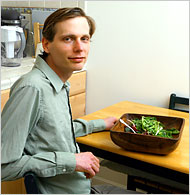
Regarding the food pictures, the photographer wanted food on plates, but I typically eat multiple servings or from a salad bowl, as in the photograph with me in the picture. The lunch and dinner pictured are low calorie density for their volume. Some people on CR eat a huge salad every day.

The clarifications above aren’t intended as criticisms. Overall the article is pretty good and I was impressed by the amount of legwork and research the reporter and support people put into the story. Seeing a real photojournalist at work was very interesting (picture of two of his cameras I took while he carried the rest of his gear down the stairs), even if I didn’t really enjoy being a subject. Maybe the MSM is worth keeping around after all. :)

There have been several stories about CR published recently. I recommend checking out The Fast Supper in New York Magazine, which features people far more hard-core and interesting than myself.

Also check out the Calorie Restriction Society. I rarely blog about CR, so subscribe to April Smith or Mary Robinson, who do so intelligently (though most people on CR seem to be male).

Better yet, ignore all of the above and contribute to the real fight against aging — from December 2005:

Excepting the very laws of nature (see arch anarchy), aging and its resulting suffering and death is the greatest oppressor of humanity. As far as I know Aubrey de Grey’s Methuselah Mouse Prize/Foundation is the only organization making a direct assault on aging, so I advise giving generously. Fight Aging! is the place to watch for new anti-aging philanthropy.

Addendum: The meal photos left out dessert.

Iraq war costing 120% too much

Sunday, October 15th, 2006

It is not completely unreasonable to guesstimate the average value of a U.S. jurisdiction citizen’s life at around $9 million, given that it has been guestimated at between $4 and $5 million in 1980 and apparently increases about 15% given a 10% increase in income. See Is Your Life Worth $10 Million? for an explanation and Economic History Services for income data.

Then it is also not completely unreasonable to guesstimate the average value of an Iraq jurisdiction citizen’s life at around $250,000, given per capita income of $3,600 at PPP.

Now assuming the Lancet study is roughly correct (I know, controversial, but if it overestimates then the Iraq war is an even worse “deal”) in estimating 600,000 Iraqi excess deaths and that the U.S. government has spent $335 billion so far on the Iraq war (only direct costs; including more controversial costs would again make the “deal” worse), it is straightforward to see that the U.S. has spent over $550,000 for each Iraqi life.

What a ripoff! And we were expecting a great deal.

(Intended as irony. Too bad if post seems autistic, outrageous, or sick.)

New world depopulation

Tuesday, May 23rd, 2006

A researcher seems to have pretty good evidence that much of the post-conquest depopulation of Mexico was due not to smallpox and other old-world diseases, but . This does not mean “maybe the Spaniards get off the hook.” It probably makes them more culpable:

[Acuña-Soto] also thinks he may have solved one of the other great mysteries of cocolitzli—namely, why it hit the Aztecs hard but left the Spanish largely unaffected.

Hemorrhagic viruses affect human populations that are already stressed, Acuña-Soto says. “The natives were poor and probably near starvation and living in unsanitary conditions where the rats would congregate. They also worked in the fields, where they’d be exposed to the rat droppings. The Spanish made up the upper classes.”

There is a tiny hint that hemorrhagic fever could have played a role in the depopulation of the Americas post-1491 but before substantial European contact (my extrapolation and emphasis):

The evidence from the Douglas firs shows that during the 16th century central Mexico not only lacked rain but also suffered the most severe and sustained drought in 500 years, one that encompassed nearly the entire continent.

(Acuña-Soto thinks hemorrhagic fever outbreaks are related to conditions immediately following severe drought.)

Via Tyler Cowen.

Calorie Restriction Conference IV, part 1

Sunday, April 9th, 2006

I attended the Fourth Calorie Restriction Society Conference after missing CR III. Comments on most of the presentations:

Conference co-organizer Robert Krikorian said he thought attendees expected less from , at least in terms of life extension, than did attendees at the first conference, held in 2001.

spoke about a small study in which overweight asthma patients practiced approximately “every other day” CR — one day, 20% of energy requirements the next — amounting to approximately 20% CR. Onset of presumably CR-induced benefits — objective and subjective measures of asthma symptoms, oxidative stress and inflammation markers — was drastic and rapid, largely kicking in after only a few weeks. Laub is also researching an unintentional human CR study from 1956 by Arias Vallejo in which 60 restricted patients in a Madrid nursing home had about half of the hospitalization days of the 60 control patients. Only half as many restricted patients as controls died over the course of the study. Laub said the mortality numbers were too small to be significant (I believe 12 and 5 deaths) but he did not let this stop him from extrapolating a mortality curve for the restricted patients shifted to the right.

Josh Mitteldorf claimed that aging is a result of to check population growth that would deplete resources and lead to extinction. He admitted to holding a minority position and offered critiques of three theories of aging. Mitteldorf thinks that the CR effect falsifies disposable soma, which he thinks should predict that more energy would allow for more damage repair and less aging rather than the opposite. I suspect he is attacking a strawman version of the theory. He claimed that the existence of genes that seem to have no purpose but programmed death and to rule out and mutation accumulation as primary causes of aging. Certainly these theories can be criticized, but Mitteldorf’s own probably goes down the wrong track by relying on group selection, which may not even exist is somewhat controversial. He invokes the dynamism of exponentially growing then crashing populations. It seems to me (i.e., completely uninformed speculation) a changing environment might favor genes for aging to free resources for new generations, which might have mutations enabling survival in changed conditions — this would be mere . Mitteldorf said the existence of programmed death would make life extension easier — single interventions could have powerful cascade effects — and that indeed, CR may be an example of such an intervention.

Luigi Fontana gave an update on human CR studies in progress that show CR practicioners have extremely low markers for cancer and heart disease risk and noted one study in which raw foodists had markers in some (but not all) areas as good as CR practicioners suggests that protein restriction may be something to study. This doesn’t seem to be of much practical use given a CR concern with maintaining muscle mass nor does it seem to be a likely effect to me — the raw foodists consumed calories closer to the CR group than to the exerciser and control groups — presumably this accounts for most or all of their CR-like markers.

suggested that the CR effect is mostly absolute and will not effectively scale for long lived organisms due to famines lasting a similar amount of time for organisms regardless of lifespan, resulting in only two or three years’ increase in life span for CR’d humans. I highly doubt multi-decade famines never happen, though perhaps they do not occur often enough to favor genes conferring equivalent life extension. Certainly the CR effect is much greater proportionately in shorter lived organisms — de Grey cited examples ranging from several hundred percent for C. elegans to a 40% for some mice to a few percent for Okinawans. He also spoke a bit about , about which I’ve written previously.

Caleb Finch’s talk on meat-adaptive genes in the evolution of the human diet was fascinating. If I understood correctly, some of the same genes that offer protection from the dangers of eating raw meat (parasites, prions, high iron doses) also indicate larger brain size, specifically . With the exception of some chimpanzees (and of course humans), existing hominids only eat plants and some insects, so this gene is not present. Some groups of chimpanzees do hunt and practice cannibalism, but this is cultural and could have even been transferred from humans. Although little recognized, Alzheimer’s occurs in many mammals. APOE also protects against Alzheimer’s. About ten percent of humans have an APOE variant that results in decreased lifespan (about half of the female-male difference) but better protection against certain diseases.

Steven Austad said that although the CR effect is often assumed to be ubiquitous many studies have shown exceptions, even in rodents. Although some of his examples are questionable, clearly the effect of CR on an organism should not be assumed to be always positive. I (because I am ignorant) found his clear description of what CR means in the context of single cell organism and fruit fly studies valuable — especially for the former, it isn’t very similar to CR for mammals. I have a fair amount of raw notes taken from this presentation which I may eventually turn into a separate post.

Three later presentations, the scientific panel, and general observations in a subsequent post.

The conference was written about in the local (Tucson) paper. Probably the two best known bloggers writing about their own CR practices, Mary Robinson and April Smith, each have posted about the conference and will presumably be posting additional thoughts.

Pro abortion

Tuesday, January 10th, 2006

Why would anyone, especially a self-styled economist say something as silly as the following?

In spite of the slander of pro-lifers, nobody is in favor of abortion. Abortion is horrible. Ask anybody who had one.

Clearly anybody who has had an favored abortion over giving birth, just as anybody who has had a root canal favored enduring the operation over an eventual jaw infection and chronic pain. People don’t bother saying “nobody is in favor of root canals.” Of course few people look forward to a medical procedure, be it abortion, root canal, hernia repair, or far more unpleasant. An economist of all people should recognize the nullity of claiming nobody favors a choice that many people actually make, given real world constraints.

I favor abortion. Strongly. Kill the parasite! I favor even more strongly, but abortion is a good backup plan.

Ten year life extension, available now

Wednesday, January 4th, 2006

Review article Three Different Paths to Age One Hundred, text posted, sans notes, maybe eventually available at the New England Centenarian Study publications page, points out some interesting data.

I’m not sure how they’re obtaining these numbers, but three studies cited claim that 25-35% of variance in longevity is can be attributed to genetic influences, leaving 65-75% to environmental effects.

A compelling example of the large impact of environment is that benefit from their otherwise nutty attempt to follow by avoiding meat, tobacco, alcohol and sloth, obtaining a life expectancy of 88 years, versus 78 years for (presumably genetically very similar) average Americans. I have heard many times that Adventists practice healthy lifestyles, but this is the first time I’ve seen a number attached to their health outcomes (not that I’ve looked).

The article also seems to generally comport with economist Robert Fogel’s research–environment early in life has long term health effects and those who achieve exceptional longevity tend to greatly delay or avoid aging related disease rather than fulfilling the stereotype of merely living longer, but in a miserable state. A healthy lifestyle may substantially increase your lifespan and simultaneously decrease the total amount of time you spend in a disabled state. What a deal.

For whatever it’s worth, the researchers at the NECS have a Living to 100 Life Expectancy Calculator. It expects me to live to 94.

MPrize impact predictions

Monday, January 2nd, 2006

Last June I wrote about Methuselah Mouse Prize related prediction market claims and suggested that claims conditioned on MPrize fundraising goals would be interesting. I just noticed that Mprize.org makes predictions of its own via its ill-explained The Life Line Equation calculator.

I couldn’t find any discussion of the calculator and it is not very prominent on the Mprize.org site. I suspect not much thought was put into it, but the implicit claims are interesting anyway. Given a year of birth, the calculator provides an expected lifespan and an estimate of funds required to reverse aging before you die, as well as a plot like the following:

One problem with the calculator is that it apparently doesn’t use . The average 75 year old is not expected to die next year, as per the calculator.

In the table below I’ve taken the output of the Life Line Equation calculator, supplemented with age-adjusted data from U.S. National Center for Health Statistics life tables (italicized).

Birth Expected
Death
Funds
Needed
1990 2072 2068 $244,000
1980 2061 2058 $407,000
1970 2050 2049 $800,000
1960 2040 2040 $2,100,000
1950 2029 2031 $9,850,000
1940 2018 2023 $226,800,000
1930 2007 2017 $40,000,000,000

The implication is that to reverse aging by 2029, the MPrize needs $9,850,000, and furthermore that aging could be reversed very shortly with enough incentive and that aging will be reversed 2030 or so regardless of MPrize funding (the funds needed to reverse aging after that date are insignificant, so I think it would be fair to discount the role of the MPrize in reversing aging after that date, if not much sooner).

MPrize funding currently stands at $1.4m, with an additional $1.8m committed. So according to MPrize.org I (born 1970) have nothing to worry about. Hooray!

Well, perhaps not. The calculator seeems pretty poorly conceived and implemented. Still, it would be very interesting to obtain estimates of the impact various levels of MPrize funding might have on anti-aging breakthroughs. Such estimates would be great marketing fodder for MPrize fundraisers–even a very modest impact would save many lives.

As I mentioned before one means of obtaining such (collective) estimates would be to condition anti-aging prediction contracts on MPrize funding levels. Very simplistically, “what is the chance aging will be reversed by 2030?” and “what is the chance aging will be reversed by 2030 if the MPrize raises $100m by 2010?” (Obviously a real claim would define some specific indicator for aging reversal, e.g., a 90 percent drop in 75 year old mortality relative to 75 year old mortality in 2005.)

I still strongly recommend supporting the Methuselah Mouse Prize and the generally.

While I’m peeving away, I wish Rejuvenation Research were an journal. “[M]most important of all: this journal needs to be read.” At $263/year for a personal online-only subscription I don’t think so.

Addendum 20060118: There is a claim on FX very much like the aging reversal claim I outlined above — 90% drop in overall death rate before 2050 relative to 1994 rate. I almost certainly read this claim in the past and forgot about it, but not its general thrust.

Outsourcing charity … to Wikipedia

Friday, December 30th, 2005

Giving and asking for recommendations for worthy charitable donations seems to be popular this time of year, so I’ll do both, following my earlier unsolicited financial advice.

Excepting the very laws of nature (see arch anarchy), aging and its resulting suffering and death is the greatest oppressor of humanity. As far as I know Aubrey de Grey’s Methuselah Mouse Prize/Foundation is the only organization making a direct assault on aging, so I advise giving generously. Fight Aging! is the place to watch for new anti-aging philanthropy.

The most important human-on-human oppression to end, in the U.S. at least, is the drug war (which directly causes oppression in other jurisdictions as well). I’ve only mentioned this in passing here. There’s too much to say. The Drug Reform Coordination Network is saying some of it. The seems to be spearheading state level liberalization initiatives. See MPP’s 2006 plan. I met MPP founder Rob Kampia a year or so ago and was left with a good impression of the organization.

is the current exemplar of the anti-authoritarian age and I love their .

Finally, you could help pay my salary at Creative Commons, more in these letters.

I’d really prefer to give entirely outside the U.S. and other wealthy jurisdictions. However, I’m not interested in any organization that gives direct aid (reactionary, low long term impact), supports education (feel good, low long term impact), exhibits economic neanderthalism, has religious or social conservative ties, or is a shill for U.S. foreign policy in the areas of drugs, terror, or intellectual property. I am looking for organizations that support autonomous liberalization or any of the goals exemplified by the organizations I already support above. Suggestions?

I suppose supporting prizes is one means of donating without respect to jurisdiction. In cases were low cost is important, researchers in cheap areas will tend to win.

I’d also prefer to give via some innovative mechanism. We’ll see what the new year brings.

Wikipedia chief considers taking ads (via Boing Boing) says that at current traffic levels, Wikipedia could generate hundreds of millions of dollars a year by running ads. There are strong objections to running ads from the community, but that is a staggering number for a tiny nonprofit, an annual amount that would be surpassed only by the wealthiest foundations. It could fund a staggering Wikimedia Foundation bureaucracy, or it could fund additional free knowledge projects. Wikipedia founder Jimmy Wales has asked what will be free. Would an annual hundred million dollar budget increase the odds of those predictions? One way to find out before actually trying.

Of course I expect all of my donations to have imperceptible impact, almost as imperceptible as voting. But it’s all about expression. I’ve increased my expressive value by including a donor comment — “in loving memory of Άναξιμένης” — with my Wikipedia donation. I got an expressive boost when my comment was chosen for highlighting.

( was a pupil or contemporary of and has a cooler sounding name. As a kid I’d dedicate donations to Alexander the Great, but I now know better.)

1491: New Revelations of the Americas Before Columbus

Wednesday, December 28th, 2005

’s essay 1491 in the March 2002 Atlantic was one of the most fascinating magazine articles I’ve read. It posited a human an natural world in the Americas prior to 1492 very unlike the one taught in history classes–large, organized human populations that thoroughly shaped their environments–and it seemed the scant evidence pointed to this world.

1491: New Revelations of the Americas Before Columbus expands on the essay and is a good read, apart from a few personal anecdotes and one painfully silly page on Inca economics. Some of the major points:

  • Humans probably 30,000 years ago, not 12,000 years ago.
  • The first complex culture in the Americas, in present-day Peru, was contemporary with ancient civilizations in the old world (beginning 3000BC).
  • Pre-1492 ecologies, including the Amazon rainforest, were engineered by humans, mostly through fire, irrigation, and planting of fruit and nut bearing trees.
  • Pre-1492 human populations were large and well organized, and not just in Mesoamerica and the Andes. Amazonia and fertile parts of the present day U.S. were heavily populated and organized. The earliest accounts by Europeans agree with this.
  • Perhaps 80 percent of the new world population died of old world diseases in the century after 1492, almost entirely without direct contact with old world humans. may have declined by 20 percent in the first 200 years.
  • New world populations were vulnerable to old world diseases and not vice versa because there weren’t many new world species suitable for domesticaion (and thus the passing of disease between humans and animals) and very little diversity in genes impacting the immune system.
  • The Spanish conquest of the and empires would have been impossible had both not been ravaged by immediately before conquest.
  • The survived with food taken from villages emptied by disease shortly before.
  • The overgrown forests, massive bison herds and pigeon flocks and similar encountered by later arriving old world descendants did not exist prior to the die off of native human populations and resulting disintegration of their socities. in particular seem to have been rare pre-contact (their bones are rare in refuse that contains bones of many types of birds eaten). The flocks of billions were an outbreak population enabled by human death or other ecological disruption resulting from contact.
  • farming did not exist pre-contact–it only becomes practical with steel axes. Clearing with stone axes would take many months, for land that can only be cultivated a few years. With steel axes, clearing can be accomplished in a week. Farmers in Amazonia instead created that could be farmed continuously through a “slash-and-char” process.
  • Present day primitive state of peoples such as the may not be ancient at all. The tree-based agriculture of Amazonia would have enabled them to abandon their farms for a short time at no permanent loss–and they would have had plenty of reason to flee from disease and Spanish slaving–but after a generation or so, especially with high mortality, their agricultural knowledge would have been lost.

Apart from Norte Chico, which appears to have only been recognized in the last decade, none of these revelations are truly new. They have been hotly debated by archeologists for many decades, with the consensus slowly coming around to support the scenario above, at least that’s what I get from reading Mann’s description of the debates.

I have changed my mind about one thing, mostly as a result of reading this book and some further reading on the topic. I used to think the Aztecs and Incas basically “had it coming” as they were super-seriously, super-outrageously, and super-bizarrely deranged by bloodthirsty religions (as opposed to the merely serious, outrangeous, and bizarre derangement of the bloodthirsty subjects of the ) that left them unable to cope with anomalous events. The pre-conquest civiliations may not have been more bloody than their contemporaries in Europe in terms of numbers killed. The appearance of pale skinned men on horses with guns is no anomaly compared to smallpox. I suspect old world civilization would have convulsed had disease worked the other way–the impact was greater than that of the .

An interesting and demystifying paper on the Aztec legal system.

I am both amazed that essentially a whole separate set of cultures and line of history existed and saddened that it is almost completely lost.

That famous passage from Adam Smith’s (1759):

Let us suppose that the great empire of China, with all its myriads of inhabitants, was suddenly swallowed up by an earthquake, and let us consider how a man of humanity in Europe, who had no sort of connexion with that part of the world, would be affected upon receiving intelligence of this dreadful calamity. He would, I imagine, first of all, express very strongly his sorrow for the misfortune of that unhappy people, he would make many melancholy reflections upon the precariousness of human life, and the vanity of all the labours of man, which could thus be annihilated in a moment. He would too, perhaps, if he was a man of speculation, enter into many reasonings concerning the effects which this disaster might produce upon the commerce of Europe, and the trade and business of the world in general. And when all this fine philosophy was over, when all these humane sentiments had been once fairly expressed, he would pursue his business or his pleasure, take his repose or his diversion, with the same ease and tranquillity, as if no such accident had happened. The most frivolous disaster which could befal himself would occasion a more real disturbance. If he was to lose his little finger to-morrow, he would not sleep to-night; but, provided he never saw them, he will snore with the most profound security over the ruin of a hundred millions of his brethren, and the destruction of that immense multitude seems plainly an object less interesting to him, than this paltry misfortune of his own.

Smith’s hypothetical was merely off by an ocean.

Persistent Flow

Monday, December 26th, 2005

Two pop psychology posts caught my eye recently. Adam Rifkin, quoting a pop business article:

[P]eople performing at a high level — in sports, the arts, and other endeavors — attain Csikszentmihalyi’s “flow state”: Time slows down, concentration comes effortlessly, distraction melts away.

Via Chris Rasch, a Psychology Today article claiming that persistence is more important than talent:

[E]xperts often speak of the “10-year rule” — that it takes at least a decade of hard work or practice to become highly successful in most endeavors, from managing a hardware store to writing sitcoms — and the ability to persist in the face of obstacles is almost always an essential ingredient in major achievements.

These observations strike me as true and complementary, though my intuition about such things comes mostly from a visceral feeling that I’m not getting on with the program.

The only brief time I’ve felt was during creation of Meta e-zine (including selling ads), but the persistent bit was not set. In other matters I’ve been fairly persistent, but at a pathetically high level of distraction (just one example).

Also from the Psychology Today article:

[P]ersistence is vital even for an indisputable genius. Mozart’s diaries, for example, contain an oft-cited passage in which the composer reports that an entire symphony appeared, supposedly intact, in his head. “But no one ever quotes the next paragraph, where he talks about how he refined the work for months,” notes Jonathan Plucker, an educational psychologist at Indiana University.

This reminds me of another pet peeve that I’ve been meaning to write about: invention is not innovation and innovation is more important than invention. For now, see Techdirt’s many posts on this theme, e.g., The Difference Between Innovation And Invention.

Ramit Sethi’s post The Myth of the Great Idea sort of hits on all of these, um, ideas.

The luxury of falling prices

Sunday, December 11th, 2005

Lasik Remains a Luxury Procedure, a new AP story that purports to look back on a decade of laser vision correction:

A lack of health insurance coverage keeps the procedure a luxury item, affordable only to people who can spare $3,000 to $5,000.

The story fails to mention that prices declined 38 percent from 1998 to 2004.

Perhaps lasik does remain a good, but the lack of price data seems like a serious omission from the story given its headline and retrospective nature. (I looked at the article because I hoped it would mention 1995-2005 price changes–it’s a pain to find data period, and moreso on a subject where most search hits basically point to advertisements.)

I won’t go for corrective vision surgery until the right combination of deterioration of my eyesight and improvement in the expected outcome of such surgery occurs–probably a decade or more from now.

I’d prefer to wait for with intelligently designed (by bio-engineers) eyes with vastly greater capabilies than my current amazing yet severely limited evolved set–better for watching the scenery from my future driverless car.

Aubrey de Grey at Stanford

Sunday, June 12th, 2005

Biogerontologist Aubrey de Grey gave lectures at Stanford Thursday evening and Friday morning. de Grey laid out his argument for life extension research at the first talk. My brief summary:

  • There are seven changes at the cellular level that accumulate and eventually cause pathology.
  • No new such changes have been discovered in over twenty years despite massively increased capability to study organisms at the cellular level in that time; seven is probably it.
  • All seven changes should be repairable at the cellular level.
  • Repair damange below levels that cuase pathology, goodbye aging.
  • If an individual lives through the first breakthrough that extends lifespan by decades they will probably survive through the next, and the next… Hello, indefinite lifespan.
  • Aging and death are barbaric and must be stopped.

de Grey calls the second to last point “escape velocity” and presented at least two arguments for it:

  • Once a breakthrough is made, science progresses in a relatively straightforward and rapid fashion for awhile.
  • Other primates’ aging is very similar to humans’, only at least twice as fast. There is time to discover and cure any new disease of extended life before any humans get it.

The second talk, apparently more intended for biologists, was a repeat of the first to a disappointing extent. I was prepared to understand very little, but de Grey only spoke for awhile on one of his proposed solutions to one of the seven types of damage–extracellular junk. The solution takes a cue from bioremediation: find microbes that break down the extracellular junk. Where? Human remains of course. From Appropriating microbial catabolism: a proposal to treat and prevent neurodegeneration:

Soil microbes display astonishing catabolic diversity, something exploited for decades in the bioremediation industry. Environments enriched in human remains impose selective pressure on the microbial population to evolve the ability to degrade any recalcitrant, energy-rich human material. Thus, microbes may exist that can degrade these lysosomal toxins. If so, it should be possible to isolate the genes responsible and modify them for therapeutic activity in the mammalian lysosome.

Neat idea. Later de Grey said that this idea is the easiest to explain to non-specialists and that the others that he has personally worked on would have required far longer to introduce than the hour lecture format allowed.

de Grey is attempting to jump start anti-aging interventions with the Methuselah Mouse Prize[s] for extending the lifespan of mice, inspired by the X Prize. His “engineering” approach sounds good to me and I wholly endorse the goal of defeating aging. I will donate more once more information is provided about the participating scientists and their mice–not much is available at this point.

There are four (unfortunately not real money) claims related to the M Prize. Three directly concern the prize:

Methuselah Mouse Postponement. Predicting a 2929 day old mouse by 2010/01/01. The current record is 1819 days.

Methuselah Mouse Post up 1 yr. Says there’s a 2/3 chance of a 2284 day old mouse by 2012/11/01. That doesn’t seem to jibe with MMPost above (time to short MMPost I think). [Correction 20060102: I misread the claim. As of 20050612 it predicted a 2284 day old mouse on 2010/02/01, which still didn't jibe with MMPost, though the discrepancy was not as bad as I thought]

Methuselah Mouse Reversal<2015. The wording of this claim could be better (the current prize holder is for 1551 days, the claim would pay 1 if 3102 day old mice were obtained by 2015/01/01). Last trade at .67, predicting a 2590 day old mouse with anti-aging interventions only begun late in life within 10 years.

Immortality in mammal by 2015. Not really immortality, but three times a species’s maximum life span as of 1996. Possibly the world’s oldest mouse in 1996 was just shy of four years. If so, this claim would predict a less than one in five chance of a 4380 day old mouse by 2015/12/31. (Another mammilian species could meet this claim.)

It would be very interesting to see versions of the above claims conditioned on the M Prize reaching some fundraising goal.

Snap Associative Decision Recall

Sunday, March 13th, 2005

Malcolm Gladwell gave an interesting afternoon keynote at SXSW today. Many others have already published extensive notes, including Matt May, Liz Lawly, Scott Benish, Tony, and Nancy White.

My two point summary of Gladwell:

  • Snap decisions play a much greater role than you’d think.
  • More information does not make for better snap decisions.

I can’t help but think there is some connection between the importance of and our ability to make snap judgements and Jeff Hawkins’ claims in On Intelligence for the primary importance of auto-associative memory and prediction recall (as opposed to computation). A brain that works as Hawkins describes should be fantastic at making snap decisions and a brain should do lots of whatever it excels at.

I’m only halfway through On Intelligence (excellent so far) and haven’t looked at Gladwell’s Blink at all.

he is HE

Thursday, February 17th, 2005

My grandfather died this morning at 99.5 years. He is now one with THE LORD ALMIGHTY in perfect nonexistence!