Archive for the ‘Iraq’ Category

Memorial Day (U.S.)

Monday, May 26th, 2008

Another year, another fine day to honor draft dodgers, deserters, and anyone with enough sense to not join the murderous gangs sponsored by any jurisdiction.

Some say it is a fine day to criticize politicians (emphasis added):

One would hope that this day, above all others, would be a time for condemning those whose lies and failures resulted in thousands of their fellow citizens being killed.

Though it may annoy to see the current temporary dictator strut with former murder gang members/slaves, now hilariously motorcycle gang members, the above leaves me with two reactions, following.

First, boredom. What day does not pass for a good day to criticize hypocritical politicians? I reserve this day for honoring those who have not taken part and those who got a clue and got out. If anyone must be condemned today, let’s keep it on the level of those actually doing the killing. Take for example this so-sad story of a gang member and gang recruiter who killed himself:

“He told me he kicked down over 1,000 doors,” Maxey said. “He was the lead guy, the first one to go in, and most of the time it was the wrong place. There would be terrified old people and little kids sitting there.”

Good riddance.

Second, the author of the first quote above is part of the problem, for buying into nationalist rhetoric. If he really had to dwell on the higher ups, he should have written this:

One would hope that this day, above all others, would be a time for condemning those whose lies and failures resulted in thousands of murders.

Bond prices on historical and contemporary civil war outcomes

Sunday, November 18th, 2007

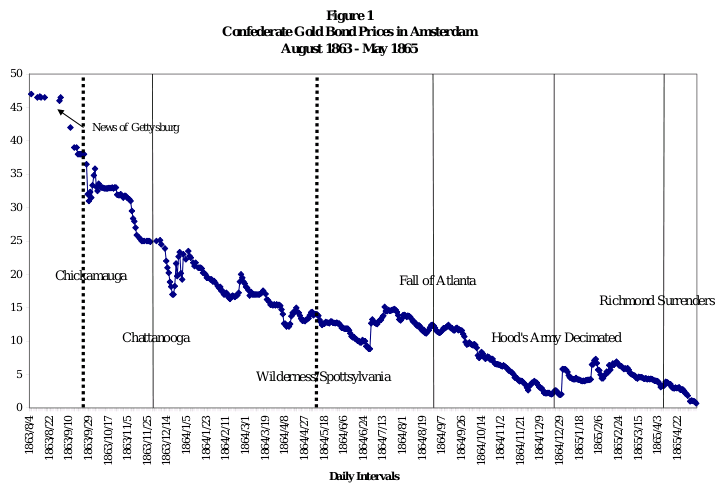
Did Johnny Reb have a Fighting Chance? A Probabilistic Assessment from European Financial Markets (PDF) by Kim Oosterlinck and Marc D. Weidenmier looks at Confederate gold bonds traded in Amsterdam from August 1863 through the end of the war, taking bond price (probability of repayment) as the probability of Confederate victory (meaning survival as an independent state that could service its debts).

A very interesting new window on history, one that is crying out to be applied to other situations were a government faces an existential threat, as the authors point out:

Although this study has focused on the American Civil War, the methodology employed in this paper could easily be applied to several other historical or modern day episodes to provide some insight into the evolution of victory probabilities during a period of civil war/revolution. The methodology might be particularly interesting to apply to a communist revolution given that Marxist regimes generally repudiate a country’s debt obligations and do not recognize international capital markets. For example, it might be interesting to know the evolution of victory (defeat) probabilities during the Spanish Civil War or the Cuban Revolution of the 1960s. Another possibility is to use the technique to estimate the probability that the thirteen colonies would win the American Revolution. The methodology could also be extended to estimate the probability of a victory by Germany during World War I or the Nazis during World War II. Applying the methodology to the world wars would be more complicated given that it is not clear whether the recovery value of the war bonds would be zero in the event of a defeat. We leave these items for future research.

What do bond prices say about contemporary Iraq? I don’t see any nice graph over time, but apparently current prices imply an 80% chance of default over the lifetime of one issue (through 2028), and apparently the “surge” hasn’t improved bond investor outlook.

Interesting, but survival of a government willing to repay past debts is way too coarse for most policy decisions and the probability of various policy decisions are not disaggregated. For these reasons prediction markets contingent on policy implementation and electoral outcomes are badly needed.

Via Robin Hanson.

1 trillion dollars, 1 million lives, 1 fraud

Sunday, November 18th, 2007

What Does Iraq Cost? Even More Than You Think. by Tyler Cowen cites sources putting the direct financial cost to the U.S. government at over $1 trillion, though Cowen’s point is that taking into account opportunity costs, the price is higher.

I don’t believe I’ve posted about this trillion dollar fraud since January 2006. I just have to point out yet again that there’s nothing unusual about Iraq: advocates of war routinely underestimate the costs by a factor of ten (which makes such estimates fraudulent, in my estimation).

Immigration

Sunday, June 10th, 2007

is a hot topic of late. I haven’t had time to write about it, so here’s a linkdump as I close tabs.

Iraqis who can are leaving Iraq, but they face severe restrictions on living and working elsewhere in the region, and the U.S. is only accepting a trickle. Tragedies abound in this NYT magazine piece, almost all worsened by anti-immigrant policies.

Landlords are beginning to be drafted to uphold apartheid in the U.S., following increased anti-employment raids.

Immigration up, unemployment down in Spain.

How much of a jerk do you have to be to oppose immigration? has been linked by many, but read if you haven’t:

Both Alex Tabarrok and Dani Rodrik have come out in favor of immigration into US on the basis that the relevant “moral community” one should consider is the world and not just the US natives. It might be the case that immigration from Mexico into US lowers the wages of the unskilled workers here (the extent of this effect is subject to some controversy, see the previous post on Ottaviano and Peri). However, the increase in the migrants’ wages is so large that support for immigration is still justified.

This kind of argument provokes the expected response from the expected folks, roughly along the lines that we should care more about native workers - the citizens - then the migrants - the non-citizens. Ok. But how much more? Let’s put on our annoying-economist hat and consider the question; if you consider a foreign national to be only 1/2 a human being (alright, alright, only 1/2 as “important”) as a native citizen, are you justified in opposing immigration? After all, it takes a real jerk to argue that foreign people’s welfare should not count at all. Suppose the foreigners are only 1/10th as important? Surely, if natives’ welfare counts for ten times as much as that of foreigners, we would be justified in banning immigration since it may adversely affect the wages of the unskilled in US? Well, let’s see…

Nathan Smith’s freedom of migration category has lots of good stuff.

CNN needs to fire Lou Dobbs.

Philippe Legrain’s Immigrants: Your Country Needs Them will be available in the U.S. June 21.

Should we end global apartheid? in today’s NYT magazine:

Indeed, Pritchett attacks the primacy of nationality itself, treating it as an atavistic prejudice. Modern moral theory rejects discrimination based on other conditions of birth. If we do not bar people from jobs because they were born female, why bar them because they were born in Nepal? The name John Rawls appears on only a single page of “Let Their People Come,” but Pritchett is taking Rawlsian philosophy to new lengths. If a just social order, as Rawls theorized, is one we would embrace behind a “veil of ignorance” — without knowing what traits we possess — a world that uses the trait of nationality to exclude the neediest workers from the richest job markets is deeply unjust. (Rawls himself thought his theory did not apply across national borders.) Pritchett’s Harvard students rallied against all kinds of evils, he writes, but “I never heard the chants, ‘Hey, ho, restrictions on labor mobility have to go.’ ”

I never understood the appeal of beginning chants with “Hey, ho”, but let’s get on with ending apartheid and destroying nationalism anyway. Atavistic prejudice, indeed.

Speaking of which, I am not fond of the term immigration, which gives special status to political borders. Migration is better. I prefer moving or relocation, regardless of distance or jurisdictions involved.

Memorial Yay

Monday, May 28th, 2007

Again this (U.S.) I honor , deserters and others not stupid enough to be darwinized at the command of their parentlandjurisdiction’s politicians.

The Probabalistic Estate

Saturday, April 21st, 2007

Chris F. Masse points out an article describing Bill Moyers’ Buying the War, to be broadcast April 25, in which many “top” journalists admit to being completely bamboozled by patriotism and the security state after 9/11. Willing fools include Dan Rather, former CBS anchor, and Walter Isaacson, former president of CNN.

My favorite article excerpt:

[E]ditors at the Panama City (Fla.) News-Herald received an order from above, “Do not use photos on Page 1A showing civilian casualties. Our sister paper has done so and received hundreds and hundreds of threatening emails.”

“Patriots” are the most likely domestic terrorists, right after the security state itself.

What if there were prediction market tickers for invasion outcomes running in the “footer” (I have no idea what the bottom of a TV screen is called, so I’ll borrow terminology) of the CBS newscast and CNN, or daily prices and inferred probabilities alongside newspaper stories?

Would the traders have been as stupid in aggregate as the journalists?

To make sense of the post title see and this.

Dying to Win: The Strategic Logic of Suicide Terrorism

Sunday, April 8th, 2007

collected data for every documented case of from 1983-2003. In he makes a strong case that suicide terrorism is almost exclusively used to combat occupation where there is a religious difference between the occupiers and occupied (together these present an existential threat to the occupied community) and the occupier jurisdiction is a democracy (and therefore less likely to reply ruthlessly and more likely to grant concessions). Furthermore, suicide terrorism seems to be relatively effective under these conditions.

Pape also dismisses two sucicide terrorism myths. First, that it is an Islam-only phenomenon (the Hindu/Marxist Tamil Tigers account for the most cases). Second, that suicide terrorists are primarily poor, uneducated and fundamentalist (they tend to have above average education and opportunities for their communities and often show now fundamentalist commitment before volunteering — an act of extreme commitment to their community by well integrated members of the same).

Although Pape has amassed significant data in support of his analysis, suicide terrorism (largely suicide bombing) has effectively only existed for a little over two decades (though suicide attacks have occasionally been used for millennia, briefly covered in this book). Will suicide terrorism change, or continue in the same pattern? There are two obvious questions, neither of which Pape bothers to pose (though I read the book a few months ago, I could’ve missed or forgotten):

  • Will suicide terrorism continue to be effective? In other words, will democracies continue to respond with a combination of concession, coercion, and grandstanding? Alternatives include apolitical response (e.g., criminal investigation and prosecution) and ruthless response (i.e., annihilation of the terrorist’s community).
  • Given that suicide terrorism is effective, will it be taken up by other groups that perceive an existential threat, e.g., radical environmentalists?

It seems that suicide bombings in Iraq, only the first several of which are included in Pape’s data, fit the pattern Pape has described. Even when not directed against the occupiers, religious difference (Shia vs. Sunni) is involved, as is the potential for influencing the democratic occupiers.

Apart from advising democracies to not occupy jurisdictions with a different predominant religion, which flows obviously from his analysis, Pape’s recommendations are irrelevant at best (e.g., lock down U.S. jurisdiction borders), as Peter McCluskey observes in his review. Nick Szabo and Chris Hibbert have also recently reviewed the book.

Invasion ethics

Saturday, January 6th, 2007

If a jurisdiction invades another, the invading jurisdiction must:

  • Grant full invader citizenship to citizens of the invaded jurisdiction upon demand, with all rights of previous citizens the invader;
  • If a supermajority in the invaded jurisdiciton desires annexation to the invader, the indvaded becomes a subjurisdiciton of the invader and all citizens of the invaded become citizens of the invader, equal to previous subjurisdictions and citizens of the invader.

A high standard? Disruptive of the politics of the invader jurisdiction? Justly so, considering the invader’s disruption of lives in the invaded jurisdiction.

A particularly savvy would-be invader may decide to skip the invasion step. Regarding Iraq, the U.S. jurisdiction is neither savvy nor responsible.

Iraq withdrawal and civilian casualties

Saturday, November 25th, 2006

I don’t follow Iraq closely, but recent headlines seem to indicate a turn for the worse and that withdrawal of U.S. troops is now on the table.

It should not have been difficult to predict that invasion would turn out badly, but politicians make the same mistakes (less charitably–tell the same lies) repeatedly, in particular when it comes to war (one reason why).

Among all the tragedies of the Iraq war, a small one is that there was no set of conditional prediction markets to consensus check (an analogue of “fact check”?) likely outcomes. An arbitrary expert can always be countered with another arbitrary expert. The nice thing about prediction markets here is that they converge to a single consensus probability (or set of interlinked probabilities for a set of claims) given the possibility of arbitrage. Faced with a market that says what a politician wants to do will probably have ill effects, the politician can ignore the consensus, but can’t counter it will an equivalent, as can be done with any expert.

So should the U.S. withdraw its military from Iraq? Unfortunately I do not know of a conditional market set up to guess the impact. Iraq-related markets I found:

Unfortunately all of these are play money markets and all only concern U.S. troops. What about Iraqi civil war or economic performance? Fortunately we can use one of these markets as an input for a conditional market that attempts to guess the impact of withdrawal on Iraq. I used the second, as it maps directly to a probability, unlike the first, and is not deemed to be an incredibly long shot, unlike the third.

The Iraqi Body Count currently says a lower bound of 47,781 Iraqi civilians have been killed since the invasion. I assume if that lower bound moves to 100,000 or greater by the end of 2007, a civil war has occurred or is in progress.

So I set up Iraq withdrawal and civilian casualties on Inkling, with four stocks:

  • USLEAV07 true AND >= 100k IBC EOY 2007
  • USLEAV07 true AND < 100k IBC EOY 2007
  • USLEAV07 false AND >= 100k IBC EOY 2007
  • USLEAV07 false AND < 100k IBC EOY 2007

I set the intial price of the first two at 12 each and the second two at 38 each, reflecting the 24 percent chance of substantial troop reduction given by Newsfutures traders and a 50/50 chance of civil war (I don’t know of a probability source for the latter). In theory prices should move to whatever traders think the probabilities actually are regardless of their initial settings.

There are two major problems with this experiment. First, a spike in violence may make troop reductions more (or less) likely, which makes it harder to divine the impact of troop reductions on violence.

Second, Inkling markets are sometimes at great variance with others or common sense, e.g., Hilary Clinton is given a 28 pecent chance of winning the 2008 Democratic nomination, others have her around 50 percent.

I surmise that there is something wrong with Inkling. That something could be just that it has no users. I set up this experiment on Inkling because it was trivial to do so, but I’d really like to see Tradesports/Intrade set up real money contracts along these lines.

Update: The first problem can be removed by ignoring deaths through April 2007. I will create a new market reflecting this…

Iraq withdrawal and civilian casualties (improved) is running with the following stocks:

  • USLEAV07 true AND IBC >= 40k May-Dec07
  • USLEAV07 true AND IBC < 40k May-Dec07
  • USLEAV07 false AND IBC >= 40k May-Dec07
  • USLEAV07 false AND IBC < 40k May-Dec07

Update 20061127: The improved market is now actually running, was previously held for admin approval.

Update 20061211: Followup posted at Midas Oracle.

Iraq war costing 120% too much

Sunday, October 15th, 2006

It is not completely unreasonable to guesstimate the average value of a U.S. jurisdiction citizen’s life at around $9 million, given that it has been guestimated at between $4 and $5 million in 1980 and apparently increases about 15% given a 10% increase in income. See Is Your Life Worth $10 Million? for an explanation and Economic History Services for income data.

Then it is also not completely unreasonable to guesstimate the average value of an Iraq jurisdiction citizen’s life at around $250,000, given per capita income of $3,600 at PPP.

Now assuming the Lancet study is roughly correct (I know, controversial, but if it overestimates then the Iraq war is an even worse “deal”) in estimating 600,000 Iraqi excess deaths and that the U.S. government has spent $335 billion so far on the Iraq war (only direct costs; including more controversial costs would again make the “deal” worse), it is straightforward to see that the U.S. has spent over $550,000 for each Iraqi life.

What a ripoff! And we were expecting a great deal.

(Intended as irony. Too bad if post seems autistic, outrageous, or sick.)

9-11 repeal

Sunday, September 10th, 2006

“Five years on” it is time to repeal the security state’s power grabs, stop the trillion dollar fuckup of Iraq and Afghanistan, and finally bring Osama bin Laden to justice.

Memorial Day

Monday, May 29th, 2006

On this (U.S.) I honor , deserters and others not stupid enough to be darwinized at the command of their parentlandjurisdiction’s politicians.

Admit defeat, not error!

Saturday, February 25th, 2006

William F. Buckley admits that the U.S. military adventure in Iraq is a defeat, but willfully fails to learn anything from it.

It is healthier for the disillusioned American to concede that in one theater in the Mideast, the postulates didn’t work. The alternative would be to abandon the postulates.

His two postulates amount to an assumption that wherever the U.S. intervenes people will act in accordance with U.S. politicians’ wishes. Nevermind that this doesn’t even work within the U.S. jurisdiction.

Buckley attributes defeat soley to “Iraqi animosities.” Even if that were the sole cause blame can be pinned firmly on U.S. politicians who were very well aware of Shiite/Sunni/Kurd/Christian/etc. “animosities” as leveraging these was a major component of U.S. policy toward Iraq after the 1991 . However, Buckley ignores economic mismanagement, and doubtless many other idiocies endemic to political management, nevermind military-political management. To do so would be to accept blame and teeter on the edge of admitting error.

If Buckley hopes to fence off his “postulates” (and thus U.S. policy) from criticism by admitting defeat in this one instance I hope he fails miserably, but I fully expect he and other advocates of interventionism will succeed in this subversion of truth. The long history of poor outcomes of U.S. intervention in the Middle East, elsewhere, and within the U.S. jurisdiction (domestically) is forgotten completely and is never learned from.

I have probably suggested too many times that prediction markets could help remind voters that the most likely outcomes are not those predicted by politicians.

On a related note: So what if Iraq splits? A jurisdiction is not a sacred entity.

Via Mike Godwin. You must check out Godwin’s awesome site design. (Don’t worry, I still hate Macs.)

Muhammad with camel

Monday, February 6th, 2006

The first thing to note about the is their timidity.

The timidity of the selection turns out to have been pure genius (mine would have aimed for maximum depravity) as it highlights just how bizarre the reaction has been.

Many have expressed disappointment in the tepid support for free speech from many western governments. I am completely unsurprised. The U.S. government and its allies have taken on around as constituents. The government of Denmark has more freedom to do the Wright thing.

As I am on a very minor photo remix kick, here is my contribution to the universe of images of Mohammed:

muhammad licking camel asshole
licking a camel’s asshole under orders from .
Original photo by Saffanna licensed under cc-by-2.0.

I believe this image complies with putative , though some may claim they see him in the camel’s face. (Yes, this is a remix with zero diff.)

How do I know Muhammad and not Jesus is with the lucky camel? Because a camel couldn’t feel an imaginary person’s licks.

Fraud of War in Iraq

Friday, January 13th, 2006

Cost of War in Iraq, a new paper from Linda Bilmes and Joseph Stiglitz, has already been discussed, at least superficially, on a large number of blogs. Comments at Marginal Revolution helpfully cite a number of related papers.

Bilmes and Stiglitz conservatively project that the total economic costs for the U.S. jurisdiction at $1 to $2 trillion. Direct budgetary costs are projected to be $750 billion to $1.2 billion. I have only skimmed the paper, which looks interesting enough, but nothing really new.

I’ve mentioned increasing cost projects several times last year and before, directly in Trillion dollar fraud (August), $700 billion fraud (July) and A lie halfway fulfilled (January 2005).

I won’t bother to explain the fraud this time, read the past posts. Hint: it involves repeatability.

One thing I’m struck by, skimming comments contesting Bilmes and Stiglitz (the political ones, not the technical ones concerning borrowing costs should be included, though they overlap) is that after the fact, I think many people would claim that the invasion was justified, economically and otherwise, regardless of the final cost. $5 trillion? (NB, that is a hypothetical, not a prediction!) It was worth getting rid of Hussein and deterring would-be Husseins. $10 trillion? Just goes to show how nasty “our” opponents are. $100 trillion? Civilization must be destroyed to save civilization!

All the more reason to be cognizant of probable costs before going to war. There’s not really a need for prediction markets here. Just multiply proponents’ estimates by ten. However, people stupidly believe words that come out of politicians’ mouths. Prediction market estimates could, ironically, provide a countervailing authority.

A better way? See Wright, Scheer, Zakaria, Hardar, Tierney, and Pape.

The Anti-Authoritarian Age

Saturday, December 24th, 2005

In a compelling post Chris Anderson claims that people are unconfortable with distributed systems “[b]ecause these systems operate on the alien logic of probabilistic statistics, which sacrifices perfection at the microscale for optimization at the macroscale.”

I suspect one could make an even stronger claim closer to people’s actual thoughts, which aren’t about probability: people crave authority, and any system that doesn’t claim authority is suspect.

The most extreme example does not involve the web, blogs, wikipedia, markets, or democracy, all of which Anderson mentions. Science is the extreme example, and its dual, religion.

Science disclaims authority and certain knowledge. Even scientific “laws” are subject to continued investigation, criticism, and revision. Religions claim certain knowledge with no evidence, only assertions of authority, and count billions as believers.

Distributed systems sacrifice claims of perfection for optimization at the macroscale.

What wikipedia really needs is the pope to declare certain articles .

On the subject of response to the ongoing rounds of wikipedia criticism, this otherwise excellent post from Rob Kaye is pretty typical:

The Wikipedians will carry on their work and in another 5 years time it will be better than encyclopedia britannica — its only a matter of time.

For me this time is measured in negative years. I loved paper encyclopedias as a kid (but was always skeptical of their content–very incomplete at best). I haven’t looked at one in years. I use wikipedia every day.

Not having access to a paper encyclopedia means I have more shelf space to work with. Not having access to wikipedia would be a severe annoyance. In another 5 years time it would be a severe disability.

Addendum 20051225: I forgot to mention another example of ready acceptance of bogus authority versus rejection of uncertain discovery: the WMD excuse for invading Iraq versus the horror at an .

Trillion dollar fraud

Wednesday, August 24th, 2005

Linda Bilmes in a recent New York Times column estimates the total outlay for the invasion and occupation of Afghanistan will come to $1.3 trillion. Christopher Westley cites a 2002 study by William Nordhaus estimating the ten year cost of an Iraq invasion at $1.2 billion:

The figure was outlandish, I was told. This was back at the time when Larry Lindsay was fired for making public his estimate that the war would cost $200 billion when the Bush Administration was estimating a cost of about half that amount.

At a glance it looks like Bilmes and Nordhaus each are including things like debt financing costs, increased veteran’s benefits and oil prices in their estimates, accouting for the half trillion increase over other recent estimates that the direct financial cost of the war could come to $700 trillion.

Regardless, it is clear and bears repeating ad nauseum that the war advocates underestimated financial costs by an order of magnitude and this radical underestimation is recurrent.

Separately, Patri Friedman just posted an article excerpt that provides one summary of how idiotic U.S. government economic (and other) policy in Iraq has been. Read it.

More broadly (sorry, can’t dig up the links right now) I’ve seen pro-war or ambivalent putatively pro-market people lament that the U.S. regime implements a centrally planned economy rather than a hoped for Hong Kong on the Euphrates, or anything close. Sorry, that hope was stupid and ignorant. Why trust the government to do the right thing in Iraq when you agree it almost never does the right thing at home? What about postwar Japan and Germany? Well, in the case of Germany anyway, the allied forces imposed price controls, one of the stupidest economic policies possible, and were aghast when Ludwig Erhard abolished the controls in 1948, paving the way for the economic miracle the U.S. wrongly takes credit for.

The average person has some excuse for believing whatever lies were told about the presence of “weapons of mass destruction”–how could one know? (Personally I find the entire topic incredibly boring. The only reason I didn’t believe is that I assume nearly every phrase uttered by a successful politician is fraudulent.) When the lies concern financial cost or economic policy, there is no excuse for belief, as the lies are basically the same every time.

1,844 Darwin Award Winners!

Wednesday, August 10th, 2005

A few brief notes on Thomas Knapp’s reply to my carping. Knapp writes:

I pay more attention to American deaths, because my goal is to influence the opinions of Americans. Americans are the ones who can bring this debacle to an end.

Understood. I have a different goal: to destroy nationalism. Here’s to our mutual success.

I know of no one who volunteers to be a “slave” when joining the US military. Doing so entails a time-delimited contractual obligation, not involuntary servitude (the contract even includes the specific provisions under which one’s enlistment may be “involuntarily” extended).

Throughout history slavery has not been a singular institution. It has sometimes been time limited. Wikipedia (emphasis added):

The 1926 Slavery Convention described slavery as “…the status or condition of a person over whom any or all of the powers attaching to the right of ownership are exercised…” Therefore a slave is someone who cannot leave an owner or employer without explicit permission, and who will be returned if they escape. Control may be accomplished through official or tacit arrangements with local authorities by masters who have some influence because of their status.

Perhaps calling soldiers slaves is a bit of a stretch, perhaps not. Soldiers are not free humans in any case.

Knapp again:

Furthermore, not only do enlistees not volunteer to be murderers, but their oath of enlistment is very specific in that it binds them to “defend and protect the Constitution of the United States,” not to randomly or non-randomly kill individuals without legitimate cause to do so.

Where defending and protecting is a tremendous stretch and includes engaging in mass murder.

And, if they realize they are being misused, it takes some big-time guts to stand up and say “no, this isn’t in my contract, no that order is not lawful, and no, I’m not going to obey it.”

I have two sets of heroes. The smart or lucky ones: draft dodgers. The stupid or unlucky ones: deserters.

But don’t fuck the kids who are dribbling their blood into the sand because they were naive enough to believe that their country would not ask them to do evil things. They’re victims in this thing as much anyone else. You can’t put someone in an insane situation and then expect sane conduct. It doesn’t work that way.

They weren’t put in an insane situation, they volunteered. Granted, many of them don’t have significant ability to think ahead. Given that lame excuse, in lieu of saying “fuck the U.S. troops” I hereby nominate the 1844 killed so far (17 additional winners since your Sunday post) for a collective darwin award.

Enough dead

Sunday, August 7th, 2005

Thomas Knapp writes:

1,827 … and counting. Enough said.

I shouldn’t pick on Knapp, whose heart is mostly in the right place (and he’s a linkmonger, so he probably won’t mind), but…

The sentiment above, that the number of U.S. government troops killed is all-important, sums up the Iraq war, or similar, pisses me off.

Those who joined the military volunteered to be slaves and volunteered to be murderers. Sure, many of them just wanted to pay for college, but most gangsters are primarily in it for the money too. Fuck the U.S. troops.

Around 25,000 Iraqi civilians have been killed in this war. (Yes, I’m aware of claims that the number is several times higher, but that estimate includes indirect deaths and is tenuous as far as I can tell, and I’m also aware of claims that an Iraqi civil war was an eventuality anyway, but that also seems highly speculative and doesn’t justify any deaths now.) They didn’t volunteer. Enough said.

But I’m all for gratuitous speech. Fuck the U.S. troops. And don’t forget to count small change or to understand real change.

Update 20050809: Thomas Knapp wrote a thorough and pleasant rejoinder, much of which I agree with. I’ll respond to the parts I don’t in a future post.

$700 billion fraud

Thursday, July 21st, 2005

Now: U.S. government spending $5.6 billion each month in Iraq and Afghanistan, not including some costs for maintenance and replacement of equipment and some training and reconstruction costs. Financial cost of Iraq war could exceed $700 billion.

Six months ago: U.S. government spending $5.4 billion each month on the two wars. I guess that financial cost of Iraq war will come to $500 billion.

Before 2003 invasion: Cost of Iraq war estimated at $50 billion, with assurances that Iraqi oil revenues would pay for much of the effort. Note missing zero.

Throughout U.S. history (and probably time immemorial): Financial cost of war consistently underestimated by a factor of ten.

Has even a single person been held accountable? Where is the clamor for a Military Planning Reform and Taxpayer Protection Act?