Public Goods

The purpose-driven voluntary sector

Sunday, January 27th, 2008

I’ve always had reservations about and similar phrasings. Nathan Smith’s alternative delights me:

I like to call this the “purpose-driven voluntary sector,” as distinct from (a) the profit-driven voluntary sector, i.e. the private sector, and (b) the purpose-driven coercive sector, i.e., the public sector.

Don’t forget the (AKA , to varying degrees). Of course there’s a fair amount of overlap.

The most exciting parts of the purpose-driven voluntary sector involve peer production.

Smith also used this terminology in an excellent comment on the nonprofit boom last October:

Some labor economists have distinguished the “intrinsic rewards” (love of the work itself) and the “extrinsic rewards” (money, benefits) from working.

By working for a non-profit, you may sacrifice some extrinsic rewards for some intrinsic rewards. As people get more and more affluent, it makes sense that more and more people will be willing to make that trade-off.

I think of non-profits as the “purpose-driven voluntary sector.” It’s distinct from the pure profit sector, officially dedicated to profits, and the government sector, which is ultimately financed through coercion. If more and more public goods can be provided through the purpose-driven voluntary sector, government can shrink.

Patri Friedman’s basic views on copyright and patents

Tuesday, December 25th, 2007

Patri Friedman just posted a nice essay concerning his basic views on copyright and patents, which I’ll summarize as “Policy should aim for economic efficiency …”:

So an economically optimal regime would have different rules for different industries, protecting some but not others, based on their exactly supply/demand curves.

“… but don’t forget about enforcement costs.”:

But really, it doesn’t matter. There is just no fucking way that IP protection is worth the police state it would take to enforce it. And unenforced/unenforceable laws poison society by teaching people not to respect the law.

This leads more or less to my understanding of the sentiment, something like “There’s nothing wrong with copyright per se, but any civil liberties infringement in the name of copyright protection is totally unacceptable.”

I recommend Friedman’s essay, but of course the reason I write is to complain … about the second half of the essay’s last sentence:

Therefore I favor accepting the inevitable as soon as possible, so that we can find new ways to compensate content producers.

This closing both gives comfort to producerists (but in the beginning of the essay Friedman says that people love to create — I agree, see paying to create — and Tom W. Bell has a separate argument that should result in less concern for producers that I’ve been meaning to blog about, but should be obvious from the title — Outgrowing Copyright: The Effect of Market Size on Copyright Policy) and is a stretch — copyright might make alternatives less pressing and interesting, but it certainly does not prevent experimentation.

While I’m complaining, enforcement costs aren’t the only often forgotten problem.

Requirements for community funding of open source

Saturday, November 24th, 2007

Last month another site for aggregating donation pledges to open source software projects launched.

I’m not sure there’s anything significant that sets Cofundos apart from microPledge featurewise. Possibly a step where bidders (pledgers) vote on which developer bid to accept. However I’m not certain how a developer is chosen on microPledge — their FAQ says “A quote will be chosen that delivers the finished and paid product to the pledgers most quickly based on their current pledging rate (not necessarily the shortest quote).” microPledge’s scheme for in progress payments may set it apart.

In terms of marketing and associations, Cofundos comes from the Agile Knowledge Engineering and Semantic Web research group at the University of Leipzig, producers of , about which I’ve written. Many of the early proposed projects are directly related to AKSW research. Their copyright policy is appreciated.

microPledge is produced by three Christian siblings who don’t push their religion.

Cofundos lists 61 proposed projects after one month, microPledge lists about 160 after about three and a half months. I don’t see any great successes on either site, but both are young, and perhaps I’m not looking hard enough.

Cofundos and microPledge are both welcome experiments, though I don’t expect either to become huge. On the other hand, even modest success would set a valuable precedent. In that vein I’ve been pretty skeptical about the chances of Fundable, they seem to have attracted a steady stream of users. Although most projects seem to be uninteresting (pledges for bulk purchases, group trips, donations to an individual’s college fund, etc), some production of public goods does seem to being funded, including several film projects in the small thousands of dollars range. Indeed, “My short film” is the default project name in their form for starting a project.

It seems to me that creating requirements and getting in front of interested potential donors are the main challenges for sites focused on funding open source software like Cofundos and microPledge (both say they are only starting with software). Requirements are just hard, and there’s little incentive for anyone to visit an aggregator who hasn’t aggregated anything of interest.

I wonder if integrating financial donations into project bug tracking systems would address both challenges? Of course doing so would have risks, both of increasing bureaucracy around processing bugs and feature requests, necessity of implementing new features (and bugs) in the relevant bug tracking software, and altering the incentives of volunteer contributors.

Via Open Knowledge Foundation Blog.

Wikimedia advertising (soft) drive

Tuesday, October 23rd, 2007

Wikipedia (actually the Wikimedia Foundation) started another yesterday. I’ll just reference what I’ve said in the past:

I am convinced by comments on the above posts and conversations since that it will take a huge shift in Wikipedia community opinion for advertising to have a chance. The time for direct argument in relevant venues is distant. If you agree with me that advertising on Wikipedia will allow the foundation to greatly speed the fulfillment of its commitment, you can make your support known without rancor:

1) When you donate, leave a comment that says “I support advertising on Wikipedia.”

2) On your Wikipedia user page (mine), add the following code, with obvious meaning (|{{PAGENAME}} may not be obvious–it’s a hack to make your name sort correctly in the relevant category listings):

[[Category:Wikipedians for optional advertisements|{{PAGENAME}}]]
[[Category:Wikipedians who think that the Wikimedia Foundation should use advertising|{{PAGENAME}}]]

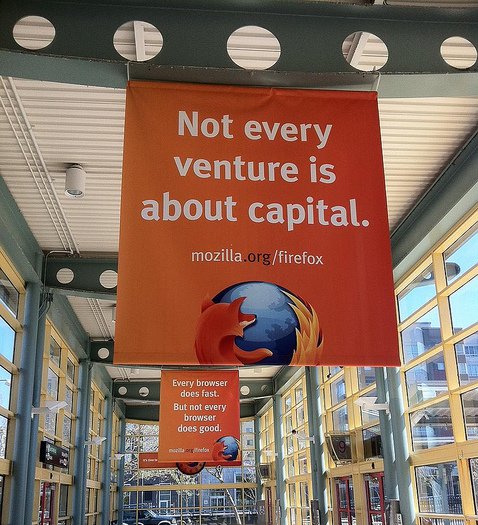
Fortuitously Mozilla posted their 2006 financial statements today:

Mozilla’s revenues (including both Mozilla Foundation and Mozilla Corporation) for 2006 were $66,840,850, up approximately 26% from 2005 revenue of $52,906,602. As in 2005 the vast majority of this revenue is associated with the search functionality in Mozilla Firefox, and the majority of that is from Google. The Firefox userbase and search revenue have both increased from 2005. Search revenue increased at a lesser rate than Firefox usage growth as the rate of payment declines with volume.

Congratulations to Mozilla. The Open Web‘s prospects would look far worse if Mozilla did not have the wisdom to exploit this revenue source. Now, what about the prospects for Free Knowledge?

Addendum 20071123: The Wikimedia Fundraiser Blog is running Why Wikipedia Does Not Run Ads, a post linked to in the fundraising ad now running on Wikipedia.

microPledge

Monday, August 27th, 2007

microPledge looks like the most interesting effort to provide a platform for funding creation of public goods through donations that I’ve seen in awhile (which isn’t saying much). Their projects could be thought of as assurance contracts — you either get the software or your money back. Would be interesting to see them attempt to offer dominant assurance contracts — … or your money back, plus. They also have what looks to be a reasonable approaches to payments to creators while a project is in progress and quitting creators.

But the amounts pledged so far are micro.

Via Erik Möller and Jeff Bone.

SXSW: Commercialization of Wikis

Saturday, March 10th, 2007

Evan Prodromou gave an excellent presentation on Commercialization of Wikis: Open Community That Pays the Bills. Check out his slides.

A few points:

  • Other stuff will be recognized as having wiki nature, e.g., .
  • Four categories of wiki businesses: service provider (Wikispaces, Wetpaint, PBWiki), content hosting (wikiHow, Wikitravel, Wikia), consulting (SocialText), content development (WikiBiz). My comment: at first blush Wikia would seem to be a service provider, but they are also deeply involved in content creation and community management.
  • Down with and the notion that wiki contributors are suckers or sharecroppers. Better to think of wikis (and wiki businesses) as platforms for knowledge. Contributors use your wiki to help each other, not to give you free content. My comment: I’m not so down on crowdsourcing. Yes, it is MBA language, but the usually involve compensating contributors. Crowdsourcing shouldn’t be conflated with sharecropping, nor confused with community purpose.
  • For wikis purpose more important than friends or ego for blogs (cf. blogs and social networking).

Seven rules for commercial wikis:

  1. Have a noble purpose — e.g., shared knowledge (use a free license), help a community.
  2. Demonstrate value — most interesting example is “carry the torch”; wiki communities can be transient, an entity that keeps focus helps.
  3. Be Transparent.
  4. Extract value where you provide value — most obviously, advertising for hosting.
  5. Be personally involved.
  6. Run with the right crowd — e.g., open source and open content, or you will be suspect of being a crowdsourcer.

It appears that Prodromou’s Wikitravel lives by these rules and has succeeded.

Update 20070317: Prodromou has a roundup of blog responses to his presentation. It was great indeed catching up with him.

Beneficial brain drain enhanced by weak intellectual protectionism

Friday, January 19th, 2007

Modern research on “” indicates it is mostly beneficial, which comports with my intuition, repeated here:

Over the long term I’d bet brains are not zero sum — a brain drain really just means increased returns to education. Mobility means more people in the developing world will pursue higher education. Add to that increased flow of knowledge and capital to the developing world from migrants and concern over “brain drain” sounds very much like yet another disingenuous excuse for keeping the current system of inter-jurisdiction apartheid in place.

The International Migration of Knowledge Workers: When Is Brain Drain Beneficial? highlights another way brain drain benefits all. Abstract (emphasis added):

We consider the welfare effects of the emigration of workers who produce a public good (knowledge). We distinguish between the knowledge diversion and knowledge creation effects of such emigration, and show that the remaining residents of a country can gain from emigration, even when tastes for knowledge goods exhibit a kind of ‘home bias’. In contrast to existing models of beneficial brain drain (BBD), our results do not require agglomeration economies, education-related externalities, remittances, return migration, or an emigration “lottery”. Instead, they are driven purely by the public nature of knowledge goods, combined with differences in market size that induce greater knowledge creation by emigrants abroad than at home. BBD is even more likely in the presence of weak sending-country intellectual property rights (IPRs), or when source country IPR policy is endogenized.

Very cool.

Via Katherine Mangu-Ward.

Wiki search advertising

Tuesday, January 16th, 2007

has launched. It’s a reasonable idea, searching Wikipedia and sites Wikipedia links to (recalling search engines that have used to seed crawls). It’s much faster than Wikipedia’s built in search, but doesn’t satisfy me, as its Wikipedia results are out of date and imcomplete (indicators of the former include turning up deleted articles and finding nothing for ‘wikiseek’).

I find it interesting that Wikiseek’s footer says:

The majority of the revenue generated by Wikiseek advertising is donated to the Wikimedia Foundation.

That’s nice — apparently Searchme, Inc., intends to use Wikisearch to demonstrate its vertical search prowess — and it inspires a potential non-intrusive revenue model for Wikipedia that precisely copies Mozilla’s: sell inclusion in the search box/search page.

This wouldn’t be worth the hundreds of millions annually that tasteful text ads on articles could be (and the ability to fully fund* the Wikimedia Foundation’s mission), but it would surely obviate the need for begging to cover the costs of running Wikipedia.

* If politicians can use that vacuous phrase to indicate they “support education” I can use it in support of funding free knowledge projects.

Jamendo ad revenue share with artists

Tuesday, January 16th, 2007

is one of the most interesting music sites on the net (in terms business, community, and technology — there’s no competition yet for the vastness and bizarreness to be found on archive.org, yet). They’re trying every Web 2.0 trick and have somehow managed to avoid becoming overwhelmed with crap. I’ve listened to dozens of the 2,100 albums on Jamendo. While only a small fraction of these have strongly agreed with my taste, just about everything (weighted toward electronica and French rock) sounds professional.

Now Jamendo has introduced an advertising revenue sharing program with participating artists.

jamendo revenue share

Several video sites are attempting variations on this theme (among them , Lulu.tv, and ), but as far as I know Jamendo’s is the first attempt in the audio space. One might think an audio site would have a harder time making web advertising work than a video site (videos are usually watched within a web page and can have clickable ad areas or bumpers even if not), but I gather that listening via (usually Flash-based) audio players embedded in web pages is increasingly common (and Jamendo upgraded theirs recently), as will be media players that “play” a web page in a browser interface.

One data point: although Jamendo heavily promotes download of high quality copies, primarily via BitTorrent, their statistics indicate that low quality http “streaming” has accounted for more bandwidth. There are many obvious caveats here, but I think all points above indicate that advertising-supported web audio should not be ruled out, even if it is granted that web video has more potential.

Digg Jamendo’s revenue share page.

I support advertising on Wikipedia

Tuesday, January 2nd, 2007

Wikimedia Foundation is over halfway through a . I hope that when you give you leave the following public comment:

I support advertising on Wikipedia.

Evan Prodromou summarizes a completely unwarranted controversy regarding a matching fund (bottom of page):

All fine so far, right? But a small logo in the donations notice — seen by non-logged-in users on every page of every WMF site — was considered by many Wikipedians and other WMF editors as dangerously close to the line on advertising — or over it. There have been several prominent users who have left the project because of it.

I’m not sympathetic with these folks; in fact, I’m in solid opposition. I think that Wikipedia’s huge amount of Web traffic is a resource that the Foundation is squandering. Traffic like Wikipedia’s is worth tens of millions if not hundreds of millions of dollars in ad revenue per year. That’s money that could go to disseminate free (libre and gratis) paperback pocket encyclopedias to millions of schools and millions of children, in their own language, around the world.

It’s irresponsible to abuse that opportunity.

I strongly agree and will repeat exactly what I said during last year’s Wikimedia fund drive:

Wikipedia chief considers taking ads (via Boing Boing) says that at current traffic levels, Wikipedia could generate hundreds of millions of dollars a year by running ads. There are strong objections to running ads from the community, but that is a staggering number for a tiny nonprofit, an annual amount that would be surpassed only by the wealthiest foundations. It could fund a staggering Wikimedia Foundation bureaucracy, or it could fund additional free knowledge projects. Wikipedia founder Jimmy Wales has asked what will be free. Would an annual hundred million dollar budget increase the odds of those predictions? One way to find out before actually trying.

In somewhat related news, Mozilla just reported 2005 financial information, showing 800% revenue growth:

In 2005 the Mozilla Foundation and Mozilla Corporation combined had revenue from all sources of $52.9M. $29.8M of this was associated with the Foundation (both before and after the creation of the Corporation). The bulk of this revenue was related to our search engine relationships, with the remainder coming from a combination of contributions, sales from the Mozilla store, interest income, and other sources. These figures compare with 2003 and 2004 revenues of $2.4M and $5.8M respectively, and reflect the tremendous growth in the popularity of Firefox after its launch in November 2004.

The combined expenses of the Mozilla Foundation and Corporation were approximately $8.2M in 2005, of which approximately $3M was associated with the Foundation. By far the biggest portion of these expenses went to support the large and growing group of people dedicated to creating and promoting Firefox, Thunderbird, and other Mozilla open source products and technologies. The rate of expenses increased over the year as new employees came on board. The unspent revenue provides a reserve fund that allows the Mozilla Foundation flexibility and long term stability.

An advertising-fueled Wikimedia Foundation could fund dozens of much needed Mozilla Firefox sized projects. And many Creative Commons (which just successfully completed its much more modest annual funding campaign) initiatives. :)

Update: Welcome Slashdot readers. The major objection to ads on Wikipedia takes two forms:

  • Advertising is profane.
  • Advertising would compromose Wikipedia’s neutrality.

A common response to the first is that those who don’t like ads can run an ad blocker. Easier still, those who don’t like ads can log in — there’s little reason to display ads to logged in users, who probably generate a tiny fraction of pageviews. But I don’t think either of these responses will satisfy this form of the objection, as it is basically emotional. Some people object to the knowledge that ads exist, even if not experienced personally. I suppose these people don’t use search engines. It’s a wonder they can stand to use the net at all. I discount them completely.

The second is completely unrealistic. How would third party text ads, e.g., via AdSense, compromise neutrality? There’s simply no vector for an advertiser to demand changes and zero reason for Wikipedians to comply. Wikipedia is not a small town newspaper beholden to the local department store, not even close. It isn’t even Slashdot, which as far as I can tell has not been compromised by years of running ads. To people with this objection: show me a community site that has gone astray due to advertiser influence.

Sponsors, “being managed by Wikipedia staff (like in newspaper ads, i.e. no uncontrolled 3rd party feeds)”, as suggested by Kuba Ober, are far more dangerous than third party ads, because then there is a vector between advertiser and someone with power at Wikipedia.

There may be an opportunity for Wikipedia to completely rethink and remake advertising, or merely compete in some fashion with what some are calling Google’s near monopoly, but now it would make tremendous sense to use AdSense or Yahoo! or both — and I suspect Wikipedia could manage to keep a greater share of revenue than a normal web publisher. Rick Yorgason mocked up what AdSense would look like in the place of the current fundraiser’s donation banner.

Slashdot commenter jklooserman summarizes objections from Wikiproject no ads:

  1. Wikipedia’s philosophy is non-commercial
  2. Ads put at risk Wikipedia’s principle of Neutral Point of View (NPOV)
  3. The information that constitutes Wikipedia is wealth for the community

I don’t see “non-commercial” in any form on the Wikimedia Foundation home page. I do see this, in large text:

Imagine a world in which every single human being can freely share in the sum of all knowledge. That’s our commitment.

The next line, all bold, asks for help in the form of donations.

Much more money, hundreds of millions, would speed the arrival of that world and fulfillment of that commitment.

As above, there is no realistic scenario for ads undermining neutrality on Wikipedia.

The third objection strikes me as a non-sequitur. In any case, the point of obtaining more resources would be to increase the wealth of the community — of all human beings.

jklooserman also pointed out that there’s a category of Wikipedians who think that the Wikimedia Foundation should use advertising. Add it to your user page if you agree.