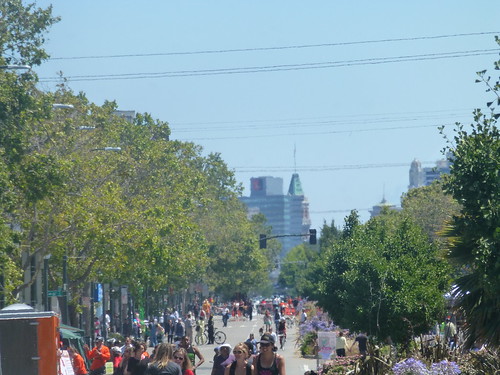
Oakland

Open Knowledge Foundation

Wednesday, February 13th, 2013

I used to privately poke fun at the Open Knowledge Foundation for what seemed like a never-ending stream of half-baked projects (and domains, websites, lists, etc). I was wrong.

(I have also criticized OKF’s creation of a database-specific copyleft license, but recognize its existence is mostly Creative Commons’ fault, just as I criticize some of Creative Commons’ licenses but recognize that their existence is mostly due to a lack of vision on the part of free software activists.)

Some of those projects have become truly impressive (eg the Public Domain Review and CKAN, the latter being a “data portal” deployed by numerous governments in direct competition with proprietary “solutions”; hopefully my local government will eventually adopt the instance OpenOakland has set up). Some projects once deemed important seem relatively stagnant, but were way ahead of their time, if only because the non-software free/open universe painfully lags software (eg, KnowledgeForge). I haven’t kept track of most OKF projects, but whichever ones haven’t succeeded wildly don’t seem to have caused overall problems.

Also, in the past couple years, OKF has sprouted local groups around the world.

Why has the OKF succeeded, despite what seemed to me for a time chaotic behavior?

  • It knows what it is doing. Not necessarily in terms of having a solid plan for every project it starts, but in the more fundamental sense of knowing what it is trying to accomplish, grounded by its own definition of what open knowledge is (unsurprisingly it is derived from the Open Source Definition). I’ve been on the advisory council for that definition for most of its existence, and this year I’m its chair. I wrote a post for the OKF blog today reiterating the foundational nature of the definition and its importance to the success of OKF and the many “open” movements in various fields.
  • It has been a lean organization, structured to be able to easily expand and contract in terms of paid workers, allowing it to pursue on-mission projects rather than be dominated by permanent institutional fundraising.
  • It seems to have mostly brought already committed open activists/doers into the organization and its projects.
  • The network (eg local groups) seems to have grown fairly organically, rather than from a top-down vision to create an umbrella that all would attach themselves toview with great skepticism.

OKF is far from perfect (in particular I think it is too detached from free/open source software, to the detriment of open data and reducing my confidence it will continue to say on a fully Open course — through action and recruitment — one of their more ironic practices at this moment is the Google map at the top of their local groups page [Update: already fixed, see comments]). But it is an excellent organization, at this point probably the single best connection to all things Open, irrespective of field or geography.

Check them out online, join or start a local group, and if you’re interested in the minutiae of of whether particular licenses for intended-to-be-open culture/data/education/government/research works are actually open, help me out with OKF’s OpenDefinition.org project.

Open Data nuance

Sunday, October 7th, 2012

I’m very mildly annoyed with some discussion of “open data”, in part where it is an amorphous thing for which expectations must be managed, value found and sustainable business models, perhaps marketplaces, invented, all with an abstract and tangential relationship to software, or “IT”.

All of this was evident at a recent Open Knowledge Foundation meetup at the Wikimedia Foundation offices — but perhaps only evident to me, and I do not really intend to criticize anyone there. Their projects are all great. Nonetheless, I think very general discussion about open data tends to be very suboptimal, even among experts. Perhaps this just means general discussion is suboptimal, except as an excuse for socializing. But I am more comfortable enumerating peeves than I am socializing:

  • “Open” and “data” should sometimes be considered separately. “Open” (as in anyone can use for any purpose, as opposed to facing possible legal threat from copyright, database, patent and other “owners”, even their own governments, and their enforcement apparatuses) is only an expensive policy choice if pursued at too low a level, where rational ignorance and a desire to maintain every form of control and conceivable revenue stream rule. Regardless of “open” policy, or lack thereof, any particular dataset might be worthwhile, or not. But this is the most minor of my annoyances. It is even counterproductive to consider, most of the time — due to the expense of overcoming rational ignorance about “open” policy, and of evaluating any particular dataset, it probably makes a lot of sense to bundle “open data” and agitate for as much data to be made available under as good of practices as possible, and manage expectations when necessary.
  • To minimize the need to make expensive evaluations and compromises, open data needs to be cheap, preferably a side-effect of business as usual. Cheapness requires automation requires software requires open source software, otherwise “open data” institutions are themselves not transparent, are hostage to “enterprise software” companies, and are severely constrained in their ability to help each other, and to be helped by their publics. I don’t think an agitation approach is optimal (I recently attended an OpenOakland meeting, and one of the leaders said something like “we don’t hate proprietary software, but we do love open source”, which seems reasonable) but I am annoyed nevertheless by the lack of priority and acknowledgement given to software by “open data” (and even moreso, open access/content/education/etc) folk in general, strategic discussions (but, in action the Open Knowledge Foundation is better, having hatched valuable open source projects needed for open data). Computation rules all!
  • A “data marketplace” should not be the first suggestion, or even metaphor, for how to realize value from open data — especially not in the offices of the Wikimedia Foundation. Instead, mass collaboration.
  • Open data is neither necessary nor sufficient for better governance. Human institutions (inclusive of “public”, “private”, or any other categorization you like) have been well governed and atrociously governed throughout recorded history. Open data is just another mechanism that in some cases might make a bit of a difference. Another tool. But speaking of managing expectations, one should expect and demand good governance, or at least less atrocity, from our institutions, completely independent of open data!

“Nuance” is a vague joke in lieu of a useful title.

Oakland city council district 1 debate Thursday: voters, please demonstrate you are not stupid, lazy, delusional

Tuesday, September 25th, 2012

I encourage Oakland residents to come to my neighborhood Thursday evening for a District 1 city council debate featuring all 7 candidates (my review of the field). The somewhat notable Actual Cafe is across the street from the venue.

The East Bay Express this week includes two highly relevant articles. The People’s Police Department: Why federal consent decrees are working in Detroit, but not in Oakland, further subtracting from Oakland excuses and blaming on external factors (also see the Los Angeles Police Department improving under a similar settlement). The city and department leadership must be fully committed to change in word and deed. Oakland’s are not, as further evidenced by Deanna Santana Tried to Alter Damning Report: Emails show that Oakland’s city administrator sought to redact portions of the Frazier Report that included strong criticisms of the police department and its handling of Occupy Oakland (an example of a police department and administration aping national military and government, in disinformation as well as physical equipment and tactics).

A continued plea to both those who just want more cops and for them to crack down hard on crime, and those who just see the cops as criminals and non-cop crime due to other oppression. Both positions lead to severe dysfunction (so does the in between position of seeing police as necessary evil and therefore not worthy of support or effective management; to the extent the police are evil it is due to bad management and bad law, all the fault of a stupid, lazy, delusional electorate). The need for law enforcement is not going away, period, and the only way effective policing is going to get the support needed is for police to behave, as a matter of course. Los Angeles and Detroit show that a quick turnaround is possible. If Oakland residents on all sides do not constructively demand and obtain such, we have only ourselves to blame for continued out of control crime and police misconduct.

Migration is Natural

Thursday, September 13th, 2012

'Migration is Natural' Mural
The mural pictured above is around the corner from where I live. I’m happy to find out that it means what I hoped — though I’d be surprised if the muralists didn’t arrive via some very different considerations. The Community Rejuvenation Project commissioned the mural and yesterday posted a photo of it with the following caption:

This piece on San Pablo by 60th st. is a collaboration between Pancho Pescador and Mike 360. The goal of this piece is to support natural migration and eliminate imaginary human borders.

Proud to have this in my neighborhood. Another visual advocating intellectual freedom nearby would make a tiny part of me feel complete.

I had not heard of before and have no opinion at this time concerning Wirikuta. Apparently some people view it as a holy site while others want to mine it. The atheist in me wants to disingenuously urge the full separation of the existing and non-existing universes, rendering any complaint about despoiling a holy site because it is holy as preposterous as believing in things that don’t exist. But I’m sure there are other, entirely naturalistic, concerns from both sides.

Oakland residents insulted by council and attorney candidates

Tuesday, August 28th, 2012

I read the websites of candidates for Oakland City Council District 1 (North Oakland), City Council At-Large, and City Attorney. With only a few exceptions, each can be compressed with no loss of information to “I ♥ Oakland. Crime sucks.” That does capture the sentiments expressed on t-shirts worn by hipsters and voiced by people who attend neighborhood meetings. But why bother running for office without additional substance? I’m insulted by the vacuity of most of the candidates.

Among the sorry lot, there’s a clear winner for each office. Vote for Len Raphael (District 1), Rebecca Kaplan (At-Large), and Barbara Parker (Attorney). Below I rank and make fun of the candidates for each of the offices.

District 1 (North Oakland)

1st) Len Raphael has the most extensive issues pages of any candidate, and he’s left at least hundreds of comments on various news sites (e.g., East Bay Express). Raphael wants more and better city government and has a sadly novel (it shouldn’t be novel) plan to pay for it — pay new city employees less. Also, while it isn’t a big deal in the grand scheme of things, I’m happy to see Raphael write “Spending money on economic development consultants and staff and promotion is mostly a waste.”

2nd) Don Macleay, a Green, is the only other district 1 candidate that has taken the time to state his position on any issues of substance. It seems he’s not part of the establishment, and from the headlines I’ve scanned Green officeholders are doing a decent job of running the nearby city of Richmond.

3rd) Dan Kalb has an issues page and promises position papers. Yes, it’s a low bar.

Honorable mention to Craig Brandt, who writes about substantial issues on his site, but sadly his proposals are rather empty, e.g., on police: “I am proposing that we begin lobbying the State to pay for the training of police officers.” Even before taking office a program reliant on (and thus able to place blame on) higher levels of government is distinctly worrying. Besides, Oakland’s two previous mayors were relative political superpowers, and their lobbying for state and federal assistance led to long term improvements in governance, right? Sure.

The following candidates should be disqualified for having nothing to say.

Richard Raya:

Richard believes the city is two or three projects away from becoming a world-class center of commerce.

Richard’s campaign is about saving lives and helping our city become all that it can be. In order to get there, the city’s government has to become more responsive to local business—and more accountable to residents. Only working together can Oakland create more jobs, better schools, and less crime.

Richard’s personal experience and his years of leadership in local government have given him the tools to help Oakland achieve this historic transformation. Running for City Council is a chance to stand up for what he believes in—and to help usher in a new generation of leadership to the city…one that’s focused on bringing people together to solve Oakland’s problems.

Don Link:

Don has a vision for Oakland, a vision with quiet, safe neighborhoods, vibrant, exciting commercial districts and an education system that keeps our kids in school, prepares them for college or for good jobs when they graduate.

Oakland already has the location, the climate, the people, and the potential to be a phenomenal city. The NY Times recognized this; those of us who live and work here also know this to be true. There are challenges that hold our city back, as Council member for District 1, Don will make sure we can solve those challenges, bring real solutions to the table and move Oakland forward.

Amy Lemley:

North Oakland is a wonderful place to live.
There is so much to love, from our vibrant neighborhoods and fantastic neighbors to our unique local merchants and award-winning restaurants.

Yet I know there is so much that could be improved.
Like you, I want the basics: safe, clean streets, good schools, and a healthy economy that benefits all Oaklanders. All of these things are within our grasp. I know, working together, we can reach them.

As your Councilmember, I will focus on the core responsibilities of city government and tackle our challenges with creativity, persistence and pragmatism. I value collaboration and civility working with colleagues, and transparency and participation when working with the public.

At-large

1st) Rebecca Kaplan, the incumbent, has an OK issues page and I rank her first for the same reason I ranked her first for mayor: the other candidates are embarrassments.

2nd) Carol Lee Tolbert doesn’t really say anything of substance, for example: “Allowing Oakland to be the most dangerous city in California is unacceptable.” I rank her on the basis of her statement “I have served the citizens of Oakland on the Oakland School Board. I took the District out of State Receivership, left it with a $10 million surplus in 1997, and created quality neighborhood schools.” If this is an accurate description of her contribution as a school board member, it seems like highly relevant experience.

3rd) Mick Storm at least realizes that something is amiss, but he really ought to have an inkling beyond that before running:

As I look at the statements and positions of the incumbent council, I find little I disagree with. My only question is, why has so little been accomplished?

Theresa Anderson-Downs is another Green candidate, who doesn’t seem to have a website. I found an announcement of her candidacy which doesn’t say much.

Ignacio De La Fuente is incumbent in District 5, a seat he is not defending in order to run for At-large. He has a web site that doesn’t mention the current race. He’s a political dinosaur that should have been run out of town long ago for saddling Oakland with millions and decades of debt to lure the owners of the Raiders football team back to Oakland.

Attorney

Incumbent Barbara Parker has an OK issues page. Jane Brunner (incumbent District 1 city councilperson) would be at home with most of the candidates for her seat: she loves Oakland. I agree with Make Oakland Better Now’s endorsement of Parker. Seeing them debate recently reinforced my impression of each: Parker is a professional, Brunner a politician, with competence and capriciousness allocated between them as one would expect.

Demand quality before quantity (re Oakland police)

Sunday, August 12th, 2012

Another SF Chronicle article about crime and police staffing in Oakland includes but does not discuss a chart of violent crimes/population and violent crimes/officer for 10 California cities.

Crimes/officer screams out to me as the statistic for which Oakland is most anomalous. This could support the assertion that I incessantly hear and read from neighbors and commenters that Oakland needs more police — each officer has a large number of crimes to deal with — often in the form of “Oakland has half the police, in ratio to population, that most major cities have.” (This seems to be true relative to some U.S. cities, but is an exaggeration relative to other California cities; I have no idea why California cities seem to all have lower police/population levels than elsewhere in the U.S.) But it could also support an assertion that Oakland’s police department is spectacularly inefficient.

Crimes/officer is a facile measure of police department efficiency in the sense that it could be improved by hiring more officers and having them do nothing. Much better would be a measure of crime reduction per officer, a much more difficult and speculative number. But given the large range of crime rate outcomes given a relatively narrow range of staffing/population among California cities, I suggest policing efficiency must be a major determinant of those outcomes.

I calculated the number of officers per 1000 population for the cities included in the Chronicle chart, and included per capita income to throw out another frequent assertion, that Oakland has lots of crime because it is poor. Below is a screen capture from my spreadsheet.

A part of me is deeply annoyed each time I hear someone complaining about lack of police staffing or supporting for-appearances measures (gang injunctions probably an example of such) or claiming that such must be expressed because something must be done because there’s a crisis. Crime has been at a high level in Oakland relative to other U.S. cities for a long time. Furthermore, many Oakland residents see the police as the enemy, and not without reason.

It seems to me that even if one has a singular goal of increasing staffing levels, it makes sense to first demand and scrutinize department effectiveness. Adding officers to an ineffective department seems like a for-appearances measure, and not a good strategy for building long-term support for increased staffing and increased resident cooperation with police (and vice versa). Admittedly this kind of fix-what-you-advocate-to-increase-its-long-term-success is a satisfying position for me, but perhaps not for many others.

Happily, it seems there is at least one organization, Make Oakland Better Now that is advocating for both more and more effective police (I’d only reverse the order). MOBN’s reporting on the OPD’s nearly decade-long non-compliance with a police misconduct settlement and how the LAPD improved drastically under a similar settlement seems like required reading for anyone who wants better policing in Oakland. This includes those expressing a desire for increased public safety, and those who hate the police — I’m extremely dubious that goading constitutes either side’s best strategy.

Internal humidity management thanks you for freezing

Wednesday, July 18th, 2012

I’ve always hated and been baffled by buildings that run air conditioning very cold when it is very hot outside. Maybe the blast of cold air feels relieving for a moment, but then, pure misery. Fear of constantly encountering cranked up AC is one of the reasons I stick to the parts of the San Francisco Bay Area that never get very hot (more or less that means SF and the parts of the East Bay that are west of the hills). Having recently spent a week in the Midwest, then a week in DC, this is on my mind. (I also hate very hot buildings when it is very cold outside, but I only recall experiencing this once, in Minneapolis.)

Perhaps my bafflement should be lessened, having just read the following (emphasis added):

As my building engineer friends tell me, keeping a balance of heat and humidity in a building is the challenge for which the technology is built (and is, incidentally, why so many commercial buildings feel so cold in the summer — they are in part setting an internal temperature that helps them manage internal humidity).

Is that true? Even if it is, doesn’t help me feel less miserable. Surely there must be a better way. It seems billions more people will regularly experience AC over the next decades. I hope for the sake of the fraction who, like me, hate differences between indoor and outdoor climate much greater than necessary for comfort, and perhaps for conserving energy, that commercial buildings worldwide don’t have to be frigid.

Go! Oakland Warriors!

Tuesday, May 22nd, 2012

A paid entertainment basketball franchise called the Warriors is apparently planning to move from Oakland to San Francisco, supposedly a turnover by Oakland officials, who are in denial.

Instead, these officials, and all Oaklanders, ought celebrate the shipping off of anti-intellectual violent extortionate spectacle. Pity not shipped off further.

Mayor Jean Quan and others ought be ashamed of lusting after paid entertainment franchise owners at all. Quan and company are fond of calling Oakland “a city of the 99%” and thus should reject the appalling wealth transfer to the tiny fraction of the 1% that is pro sports. The team owners claim “no new taxes” for San Franciscans. Yeah, right, and I have a second Bay Bridge to sell you. All of their incentives point to beggaring the municipality forever more.

Previous: Things that bring all the classes and cultures in a community together.

Ban* human drivers somewhere by 2020

Saturday, April 28th, 2012

Read Brad Templeton’s latest post on self-driving cars, which has a number of updates. They’re coming fast, but how fast we drastically reduce transportation deaths, give people back a huge amount of time, reduce stress, and greatly reduce space and other resources dedicated to transportation, and how secure new systems are, is undetermined. Of course there are many reasons to be skeptical — the transition will probably be much slower and more problematic than needed, but in a few decades will still seem a major triumph. But I don’t want the hidden trillions of dollars, hours, lives, carbon emissions, malfunctions, etc. that could be saved sooner to be wasted.

Regarding security, malfunctions, etc., we need to demand use of proven secure protocols and source open to inspection, i.e, not play security through obscurity. Regarding space, planning for urbanity remade (largely, recovered) through autonomous vehicles needs to be the top urban planning priority.

The benefits will be so great that we should also think about how to speed adoption — the only disheartening news in Templeton’s post concerns a survey in which only 20% of car buyers would pay an additional $3,000 for a fully (if I understand correctly) self-driving car. How little respondents value their own time and lives, let alone others’! It’s time to start agitating for road owners to ban human drivers. Most road owners are governments, but not all — consider as an issue of public policy or consumer demand as you wish.

Won’t banning human drivers disadvantage poor people who can’t afford a self-driving car? Possibly very briefly, but on net I expect self-driving cars to have an egalitarian effect — they’ll make owning a vehicle at all unnecessary (a rental can be summoned on demand), reduce housing costs (of which parking is a big part), and allow the recovery of areas walled off and drowned out by highways.

Let’s ban human drivers from at least some roads by 2020. I suggest starting with San Pablo Avenue in Oakland, Emeryville, and Berkeley — because I live close to it! Admittedly a downtown area or certain lanes of a highway might be an easier start.

*In theory it is usually preferable to increase prices rather than ban altogether. In this case, obvious mechanisms would include drastically increasing driver license fees and tolls for vehicles with human drivers. In practice, a ban may be more feasible.

Announcing RichClowd: crowdfunding with a $tatus check

Sunday, April 1st, 2012

RichClowd

Oakland, California, USA — 2012 April 1

Today, RichClowd pre-announces the launch of RichClowd.com, an exclusive “crowdfunding” service for the wealthy. Mass crowdfunding sites like Kickstarter have demonstrated a business model, but are held back by the high transaction costs of small funds and non-audacious projects proposed by under-capitalized creators. RichClowd will be open exclusively to funders and creators with already substantial access to capital.

The wealthy can fund and create audacious projects without joining together, but mass crowdfunding points to creative, marketing, networking, and status benefits to joint funding. So far mass crowdfunding has improved the marketplace for small projects and trinkets. The wealthy constitute a different strata of the marketplace — in the clouds, relatively — and RichClowd exists to improve the marketplace for monuments, public and personal, and other monumental projects.

“Through exclusivity RichClowd will enable projects with higher class, bigger vision, and that ultimately long-lasting contributions to society”, said RichClowd founder Mike Linksvayer, who continued: “Throughout human history great people have amassed and created the infrastructure, artifacts and knowledge that survives and is celebrated. As the Medicis were to the renaissance, RichClowders will be to the next stage of global society.”

RichClowd will initially have a membership fee of $100,000, which may be applied to project funding pledges. To ensure well-capitalized projects, RichClowd will implement a system called Dominant Assurance Contracts, which align the interests of funders and creators via a refund above the pledged amount for unsuccessful projects. This system will require creators to deposit the potential additional refund amount prior to launching a RichClowd project.

For the intellectual products of RichClowd projects, use of a forthcoming RichClowd Club License (RCCL) will be encouraged, making outputs maximally useful to funders, while maintaining exclusivity. Egalitarian projects will have the option of using a free public license.

The technology powering RichClowd.com will be developed openly and available under an AGPL open source badgeware intellectual property license. “RichClowd believes in public works. In addition to the many that will be created via the RichClowd service, open development of the RichClowd.com technology is the company’s own direct contribution to the extraordinary public work that is the Internet”, said Linksvayer.

About RichClowd

RichClowd is a pre-launch exclusive crowdfunding service with a mission of increasing the efficiency of bringing together great wealth and great projects to make an amazing world. Based in Oakland, California, a city with a reputation for poverty and agitation, RichClowd additionally takes on the local civic duty of pointing out Oakland’s incredible wealth and wealthy residents: to begin with, look up at the hills.

Contact

Mike Linksvayer, Founder
biginfo@richclowd.com